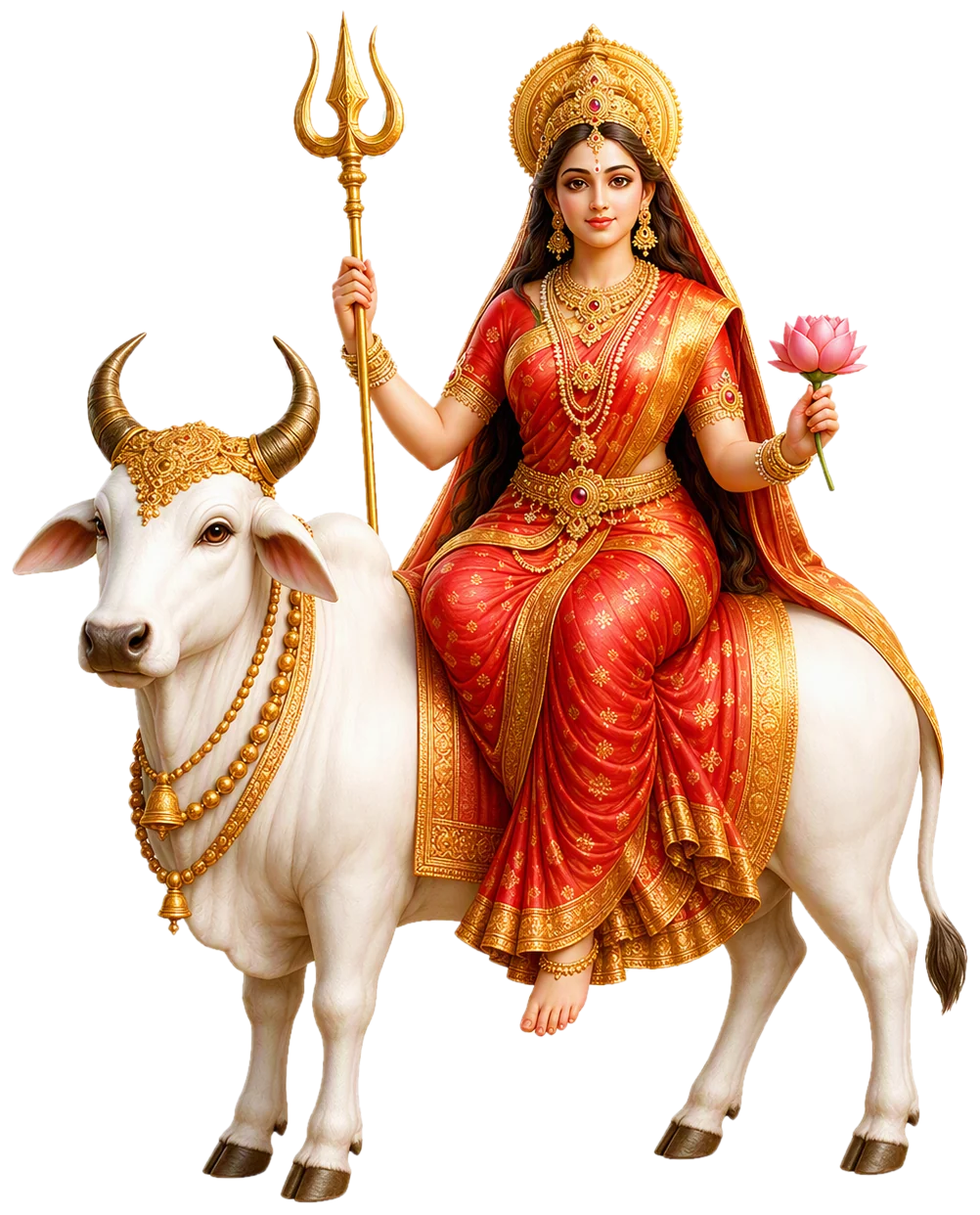
- Navratri day
- Day 1
- Date in 2027
- Thursday, 30 Sep 2027
- Colour in 2027
- Yellow
- Vahan
- Bull (Nandi)
- Prasad / bhog
- Pure desi ghee
- Tithi at sunrise
- Pratipada (from 8:05 AM)
About Maa Shailputri
Shailputri means "daughter of the mountain". She was born to Himavan, king of the Himalayas, and is seen as a rebirth of Sati, who gave up her life after her father Daksha insulted Lord Shiva. In this birth she again became the wife of Shiva.
She is shown with a trishul in her right hand and a lotus in her left, riding the bull Nandi. Because she is the first of the nine forms, her worship sets the tone for the whole festival, and many families begin the fast on this day.
The katha of Maa Shailputri
In her previous birth she was Sati, the devoted wife of Lord Shiva, who gave up her body when her father Daksha insulted her husband. She was reborn as the daughter of the Himalayas — Shailputri, “daughter of the mountain.” Riding the bull Nandi, holding a trident and a lotus, with the crescent moon on her forehead, she is the first form worshipped in Navratri, and her puja begins with Ghatasthapana — the sowing of barley and the installation of the kalash. She teaches that devotion, once resolved, is reborn stronger in every life.
Puja vidhi
- Do Ghatasthapana in the morning muhurat, then take the sankalpa for the nine days.
- Place Maa Shailputri's picture near the kalash and offer roli, akshat and red or orange flowers.
- Offer pure desi ghee as bhog, or a sweet made in ghee. Many families give the ghee to the needy afterwards.
- Chant her mantra 108 times if you can, read the Durga Saptashati or the Devi Kavach, and end with the aarti.
Mantra
Mantra
ॐ देवी शैलपुत्र्यै नमः॥
Om Devi Shailaputryai Namah
Dhyana mantra
वन्दे वाञ्छितलाभाय चन्द्रार्धकृतशेखराम्। वृषारूढां शूलधरां शैलपुत्रीं यशस्विनीम्॥
Vande vanchhitalabhaya chandrardhakrita-shekharam, vrisharudham shuladharam Shailaputrim yashasvinim.
Recite this while picturing the Devi before you begin the puja.
Stuti
या देवी सर्वभूतेषु माँ शैलपुत्री रूपेण संस्थिता। नमस्तस्यै नमस्तस्यै नमस्तस्यै नमो नमः॥
Ya Devi sarvabhuteshu Maa Shailputri rupena samsthita, namastasyai namastasyai namastasyai namo namah.
Aarti
Aarti: Om Jai Ambe Gauri
This is the aarti of Maa Durga (Ambe Maa) sung every evening of Navratri, whichever form is worshipped that day. It is traditionally credited to Shivanand Swami, as its last verse says.
जय अम्बे गौरी, मैया जय श्यामा गौरी। तुमको निशदिन ध्यावत, हरि ब्रह्मा शिवरी॥ ॐ जय अम्बे गौरी॥
Jai Ambe Gauri, Maiya Jai Shyama Gauri, Tumko nishdin dhyavat, Hari Brahma Shivri. Om Jai Ambe Gauri.
माँग सिंदूर विराजत, टीको मृगमद को। उज्ज्वल से दोउ नैना, चंद्रवदन नीको॥
Maang sindoor virajat, tiko mrigmad ko, Ujjval se dou naina, chandravadan neeko.
कनक समान कलेवर, रक्ताम्बर राजै। रक्तपुष्प गल माला, कंठन पर साजै॥
Kanak saman kalevar, raktambar raajai, Raktapushp gal mala, kanthan par saajai.
केहरि वाहन राजत, खड्ग खप्पर धारी। सुर-नर-मुनिजन सेवत, तिनके दुखहारी॥
Kehari vahan raajat, khadag khappar dhaari, Sur-nar-munijan sevat, tinke dukhhaari.
कानन कुण्डल शोभित, नासाग्रे मोती। कोटिक चंद्र दिवाकर, सम राजत ज्योती॥
Kaanan kundal shobhit, nasagre moti, Kotik chandra divakar, sam raajat jyoti.
शुंभ-निशुंभ बिदारे, महिषासुर घाती। धूम्र विलोचन नैना, निशदिन मदमाती॥
Shumbh-Nishumbh bidaare, Mahishasur ghaati, Dhumra vilochan naina, nishdin madmaati.
चण्ड-मुण्ड संहारे, शोणित बीज हरे। मधु-कैटभ दोउ मारे, सुर भयहीन करे॥
Chand-Mund sanhaare, Shonit Beej hare, Madhu-Kaitabh dou maare, sur bhayheen kare.
ब्रह्माणी, रुद्राणी, तुम कमला रानी। आगम निगम बखानी, तुम शिव पटरानी॥
Brahmani, Rudrani, tum Kamala Rani, Agam Nigam bakhaani, tum Shiv patrani.
चौंसठ योगिनी मंगल गावत, नृत्य करत भैरों। बाजत ताल मृदंगा, अरु बाजत डमरू॥
Chausath yogini mangal gaavat, nritya karat Bhairon, Baajat taal mridanga, aru baajat damru.
तुम ही जग की माता, तुम ही हो भरता। भक्तन की दुख हरता, सुख संपति करता॥
Tum hi jag ki mata, tum hi ho bharta, Bhaktan ki dukh harta, sukh sampati karta.
भुजा चार अति शोभित, वर मुद्रा धारी। मनवांछित फल पावत, सेवत नर नारी॥
Bhuja chaar ati shobhit, var mudra dhaari, Manvanchhit phal paavat, sevat nar naari.
कंचन थाल विराजत, अगर कपूर बाती। श्रीमालकेतु में राजत, कोटि रतन ज्योती॥
Kanchan thaal virajat, agar kapur baati, Shrimalketu mein raajat, koti ratan jyoti.
श्री अम्बेजी की आरती, जो कोई नर गावै। कहत शिवानंद स्वामी, सुख-सम्पत्ति पावै॥
Shri Ambeji ki aarti, jo koi nar gaave, Kahat Shivanand Swami, sukh-sampatti paave.
Significance
Shailputri stands for steadiness and strength, the qualities of the mountain she was born to. In yogic tradition her worship is linked with the Muladhara (root) chakra, which is why Day 1 is about building a firm base for the days of fasting and prayer ahead.
Day 1 in 2027: tithi and timings
Day 1 falls on Pratipada tithi. Ghatasthapana is done this morning, and the akhand jyoti is usually lit today.
| Date | Tithi at sunrise | Sunrise | Sunset | Moonrise | Rahu Kaal |
|---|---|---|---|---|---|
| Wed, 29 Sep | Chaturdashi until 10:54 AM, then Amavasya | 6:13 AM | 6:10 PM | No moonrise | 12:11 PM – 1:41 PM |
| Thu, 30 Sep | Amavasya until 8:05 AM, then Pratipada | 6:13 AM | 6:09 PM | 6:19 AM | 1:40 PM – 3:10 PM |
| Fri, 1 Oct | Dwitiya (Pratipada ended at 5:34 AM) | 6:14 AM | 6:08 PM | 7:24 AM | 10:41 AM – 12:11 PM |
On this day Rahu Kaal falls in the afternoon, well after the usual morning puja, and it does not clash with the Ghatasthapana muhurat. What sunrise, moonrise and Rahu Kaal mean
Timings are calculated for New Delhi in Indian Standard Time. Tithi start and end times are the same moment across India, but sunrise, sunset, moonrise, Rahu Kaal and muhurats change with your city. Other panchangs may differ by a minute or two.
Questions about Navratri 2027
When is Maa Shailputri worshipped in Navratri 2027?
Maa Shailputri is worshipped on Day 1 of Navratri 2027, Thursday, 30 September (Pratipada). Ghatasthapana is done the same morning, 8:05 AM to 10:12 AM (New Delhi).
What colour is worn on Day 1 of Navratri 2027?
The colour for Day 1, Thursday, 30 September 2027, is Yellow.
What bhog is offered to Maa Shailputri?
Maa Shailputri is offered pure desi ghee as bhog. Her vahan is a bull (Nandi).
When is Sharad Navratri in 2027?
Sharad Navratri 2027 begins on Thursday, 30 September with Ghatasthapana and ends with Maha Navami on Friday, 8 October. Dussehra (Vijayadashami) is on Saturday, 9 October 2027.