- Festival
- Diwali / Lakshmi Puja
- Date
- Friday, 29 October 2027
- Lakshmi Puja Muhurat (Delhi / New Delhi)
- 6:34 PM – 7:05 PM
- Tithi
- Kartik Amavasya
- Amavasya Tithi
- 8:47 PM, 28 October – 7:05 PM, 29 October
- Pradosh Kaal (New Delhi)
- 5:39 PM – 8:13 PM
- Vrishabha Kaal begins (New Delhi)
- 6:34 PM
- Sunset (New Delhi)
- 5:39 PM
- The five days of Diwali 2027
- Dhanteras — Wednesday, 27 October 2027 · Choti Diwali (Narak Chaturdashi) — Thursday, 28 October 2027 · Lakshmi Puja (Diwali) — Friday, 29 October 2027 · Govardhan Puja — Saturday, 30 October 2027 · Bhai Dooj — Sunday, 31 October 2027
All muhurat timings on this page are for Delhi (New Delhi, IST). City-wise timings are given in the table below. Timings in another city can differ by a few minutes, so please confirm with a local panchang where the exact minute matters.
In 2027, Diwali (Lakshmi Puja) falls on Friday, 29 October 2027. Diwali 2026 was celebrated on Sunday, 8 November 2026. The 2026 city timings and five-day dates are kept further down this page for reference. Kali Puja 2027 is on the night of Thursday, 28 October (Nishita 11:39 PM – 12:30 AM in New Delhi, 10:55–11:45 PM in Kolkata). 2027 calendar
Lakshmi Puja Muhurat in Major Cities — Friday, 29 October 2027
The Lakshmi Puja muhurat is the time when three things overlap: Pradosh Kaal (the first fifth of the night after sunset), the fixed (Sthir) Vrishabha lagna, and the Amavasya. In 2027 the Amavasya ends at 7:05 PM on 29 October, at the same moment all over India, so every muhurat below ends at 7:05 PM. In Mumbai the Vrishabha lagna rises only at 7:07 PM, after the Amavasya has ended, so the muhurat there is the Pradosh Kaal while the Amavasya lasts. The full Pradosh Kaal and the rising of Vrishabha are shown under each muhurat.
| City | Lakshmi Puja Muhurat (29 Oct 2027) |
|---|---|
| New Delhi | 6:34 – 7:05 PM Pradosh Kaal 5:39 – 8:13 PM · Vrishabha lagna from 6:34 PM |
| Mumbai | 6:07 – 7:05 PM (Pradosh only: Vrishabha rises after the Amavasya ends) Pradosh Kaal 6:07 – 8:37 PM · Vrishabha lagna from 7:07 PM |
| Kolkata | 6:00 – 7:05 PM Pradosh Kaal 5:01 – 7:33 PM · Vrishabha lagna from 6:00 PM |
| Chennai | 6:47 – 7:05 PM Pradosh Kaal 5:43 – 8:11 PM · Vrishabha lagna from 6:47 PM |
| Bengaluru | 6:58 – 7:05 PM Pradosh Kaal 5:54 – 8:22 PM · Vrishabha lagna from 6:58 PM |
| Hyderabad | 6:48 – 7:05 PM Pradosh Kaal 5:46 – 8:16 PM · Vrishabha lagna from 6:48 PM |
| Pune | 7:04 – 7:05 PM Pradosh Kaal 6:03 – 8:33 PM · Vrishabha lagna from 7:04 PM |
| Ahmedabad | 7:02 – 7:05 PM Pradosh Kaal 6:04 – 8:36 PM · Vrishabha lagna from 7:02 PM |
| Jaipur | 6:43 – 7:05 PM Pradosh Kaal 5:46 – 8:20 PM · Vrishabha lagna from 6:43 PM |
| Chandigarh | 6:32 – 7:05 PM Pradosh Kaal 5:38 – 8:13 PM · Vrishabha lagna from 6:32 PM |
| Gurgaon | 6:35 – 7:05 PM Pradosh Kaal 5:40 – 8:14 PM · Vrishabha lagna from 6:35 PM |
| Noida | 6:34 – 7:05 PM Pradosh Kaal 5:38 – 8:13 PM · Vrishabha lagna from 6:34 PM |
In Pune (one minute) and Ahmedabad (three minutes) the Vrishabha window inside the Amavasya is very short. For Chennai, Bengaluru, Hyderabad and Pune, Drik Panchang lists the whole Pradosh Kaal within the Amavasya (sunset to 7:05 PM) as the muhurat; families who cannot complete the puja in the short Vrishabha window can use that wider window.
Sources for all 12 cities: sunset, Pradosh Kaal, Vrishabha lagna and the Amavasya end from Drik Panchang (Lakshmi Puja pages for New Delhi, Mumbai, Kolkata, Chennai, Bengaluru, Hyderabad, Pune and Chandigarh; day-panchang pages for Ahmedabad, Jaipur and Gurgaon; lagna tables for New Delhi, Ahmedabad, Gurgaon and Noida), checked against SwarnSiddhi, SatMarg Astro, Kundlinova and our own calculation. Jaipur's Vrishabha time (6:43 PM) and Noida's sunset (5:38 PM) are confirmed by those sources and our calculation, as Drik's page for them could not be read. The other panchangs end the Amavasya at 7:06 PM and some give Vrishabha a minute later; we follow Drik Panchang. The 2026 table below is kept unchanged for reference.
Diwali 2026 (past): Lakshmi Puja Muhurat in Major Cities — Sunday, 8 November 2026
Diwali 2026 has passed. These are the 2026 timings, kept unchanged for reference; for 2027 use the table above.
| City | Lakshmi Puja Muhurat (8 Nov 2026) |
|---|---|
| New Delhi | 5:54 PM – 7:50 PM |
| Mumbai | 6:27 PM – 8:27 PM |
| Kolkata | 5:20 PM – 7:18 PM |
| Chennai | 6:07 PM – 8:09 PM |
| Bengaluru | 6:17 PM – 8:20 PM |
| Hyderabad | 6:07 PM – 8:08 PM |
| Pune | 6:24 PM – 8:24 PM |
| Ahmedabad | 6:22 PM – 8:20 PM |
| Jaipur | 6:03 PM – 7:59 PM |
| Chandigarh | 5:52 PM – 7:46 PM |
| Gurgaon | 5:55 PM – 7:51 PM |
| Noida | 5:54 PM – 7:49 PM |
What is Diwali?
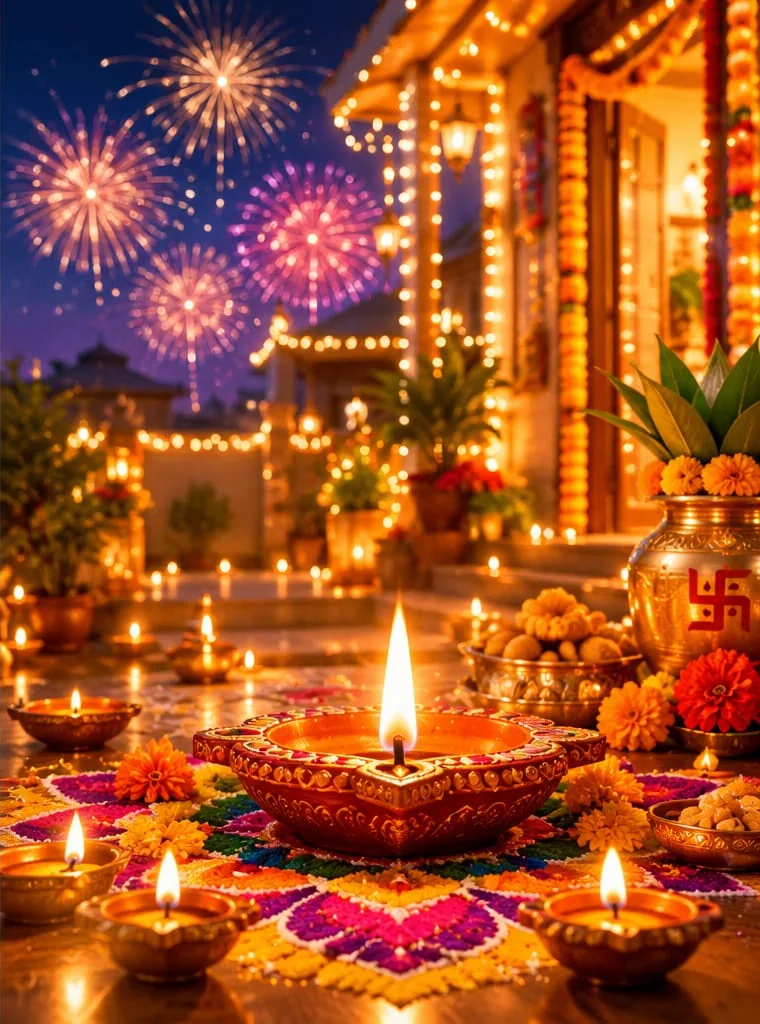
Diwali, also called Deepavali, is the festival of lights. It is kept on Kartik Amavasya, the new-moon night of the month of Kartik, when homes, temples and whole streets glow with diyas and strings of lights.
In 2027 it falls on Friday, 29 October, the biggest day of the five-day Diwali sequence that runs from Dhanteras on 27 October to Bhai Dooj on 31 October. (In 2026 it was kept on Sunday, 8 November.)
In the days before, houses are cleaned and decorated with toran and rangoli. On Diwali evening families light diyas, worship Goddess Lakshmi and Lord Ganesh together, and then share sweets with relatives, friends and neighbours.
The five days of Diwali 2027
| Date | Day / Festival | In brief |
|---|---|---|
| Wednesday, 27 October 2027 | Dhanteras | Kartik Krishna Trayodashi · the first day of Diwali · Delhi puja muhurat 6:42–8:14 PM; Yama Deepam in the evening |
| Thursday, 28 October 2027 | Choti Diwali · Narak Chaturdashi | Kartik Krishna Chaturdashi · Abhyang Snan 5:06–6:30 AM (New Delhi); Kali Puja on the night of 28 October. Where Kali Chaudas is kept on the night of Chaturdashi (as in Gujarat), it falls on the night of 27 October |
| Friday, 29 October 2027 | Diwali · Lakshmi Puja | Kartik Amavasya · Delhi Lakshmi Puja muhurat 6:34–7:05 PM |
| Saturday, 30 October 2027 | Govardhan Puja · Annakut · Vishwakarma Day | Kartik Shukla Pratipada · Govardhan Puja 6:31–8:45 AM and 3:25–5:38 PM (New Delhi); also the Gujarati New Year |
| Sunday, 31 October 2027 | Bhai Dooj | Kartik Shukla Dwitiya · tilak in the afternoon, 1:11–3:24 PM (New Delhi) |
In 2027 Amavasya ends at 7:05 PM on 29 October, so Govardhan Puja follows the next morning, 30 October, with no gap day, and Bhai Dooj is on 31 October.
Diwali 2026 (past): the five days
| Date | Day / Festival | In brief |
|---|---|---|
| Friday, 6 November 2026 | Dhanteras | Kartik Krishna Trayodashi · the first day of Diwali · new utensils, Lakshmi-Kuber puja, Yama Deepam |
| Saturday, 7 November 2026 | Choti Diwali · Kali Chaudas / Narak Chaturdashi | Kartik Krishna Chaturdashi · the first lamps; Kali Puja at night in many places |
| Sunday, 8 November 2026 | Diwali · Lakshmi Puja | Kartik Amavasya · Delhi Lakshmi Puja muhurat 5:54–7:50 PM |
| Monday, 9 November 2026 | Gap day / Vishwakarma Day | Amavasya until 12:31 PM · the tradition of worshipping tools and machines the day after Diwali |
| Tuesday, 10 November 2026 | Govardhan Puja · Annakut | Kartik Shukla Pratipada · Govardhan and Annakut; also the Gujarati New Year |
| Wednesday, 11 November 2026 | Bhai Dooj | Kartik Shukla Dwitiya · tilak in the afternoon |
In 2026 Amavasya ends at midday on 9 November, so Govardhan Puja and Bhai Dooj fall on 10 and 11 November.
The stories behind Diwali
Samudra Manthan and the appearance of Maa Lakshmi
When the devas and the asuras churned the ocean of milk in search of amrit, treasure after treasure rose from the waves. One of them was Goddess Lakshmi herself, seated on a lotus, and she chose Lord Vishnu as her consort. She is the giver of prosperity, wellbeing and good fortune, and this is why Diwali night is the night of Lakshmi Puja: homes are cleaned, lit and made ready to welcome her.
The Ramayana in short
Long ago, in the kingdom of Ayodhya, King Dasharatha ruled with dharma. In his home was born Shri Ram — truthful, kind and brave — and his arrival filled Ayodhya with joy. When Ram grew up, he travelled to Janakpur, where King Janak had set a condition for his daughter Sita's swayamvar: whoever could lift and string the great bow of Lord Shiva would marry her. Mighty kings had failed, but Ram lifted the bow and it broke as he strung it — and Ram and Sita were married. Some time later, because of a promise given to Queen Kaikeyi, Ram accepted fourteen years of exile with a smile, keeping his father's word. Sita and Lakshman lovingly went with him to the forest.
There, Ravan of Lanka, through the trick of a golden deer, carried Sita away. Searching for her, Ram and Lakshman reached Mount Rishyamuk, where they met Hanuman ji and the vanara king Sugriv, who promised his army's help. Hanuman ji carried Ram's message across the ocean to Lanka and found Maa Sita in the Ashok Vatika; he showed her Ram's ring, and she gave her chudamani in return — hope was alive again. The vanara army then built a bridge of stones across the sea — it is said the stones floated because they bore Ram's name — and Ravan's brother Vibhishan, choosing dharma, joined Ram.
In the great battle, the giant Kumbhkaran fell; then came the mighty Meghnad, whose arrows struck Lakshman unconscious. Hanuman ji flew to the Himalayas and, unable to pick out the Sanjeevani herb in time, carried back the whole mountain — and Lakshman rose again. At last Shri Ram defeated Ravan, and dharma and goodness triumphed. Ram, Sita and Lakshman returned to Ayodhya on a moonless Amavasya night, and the people welcomed them with rows of lamps lit in every home. From those rows of diyas, the festival took its name — Deepavali, the festival of lights.
Shri Ram returns to Ayodhya
After fourteen years of exile, Shri Ram came home to Ayodhya with Sita and Lakshmana. The people of the city lit lamps along every street and rooftop to welcome them back through the dark night. Every diya lit on Diwali carries the same meaning: light over darkness, and good over evil.
How Diwali is celebrated today
- Dhanteras: the house is cleaned and the festival begins; families do the Lakshmi-Kuber puja, light the Yama Deepam at the doorway and buy new utensils, as tradition goes.
- Choti Diwali / Narak Chaturdashi: an early bath, the first diyas of the festival and the remembrance of good winning over evil; in some regions Kali Puja is held at night.
- Lakshmi Puja: in the evening the home is lit with diyas, rangoli and toran, Goddess Lakshmi and Lord Ganesh are worshipped together, and kheel-batashe, sweets and prasad are offered and shared.
- Vishwakarma Day / the gap day: where the tradition is kept, tools, machines and the place of work are cleaned and worshipped.
- Govardhan Puja: Govardhan and the Annakut are offered, cows are cared for, and thanks are given to nature.
- Bhai Dooj: sisters apply tilak to their brothers, and both pray for each other's wellbeing.
The 2027 muhurat, puja vidhi and mantras for each day are on our day guides for Dhanteras, Choti Diwali, Lakshmi Puja, Govardhan Puja and Bhai Dooj; the 2026 timings are on the November 2026 festivals page; the 2027 dates are in the 2027 festival calendar.
Questions about Diwali 2027
When is Diwali in 2027?
In 2027, Diwali (Lakshmi Puja) falls on Friday, 29 October 2027.
What is the Lakshmi Puja muhurat in Delhi on Diwali 2027?
6:34 PM to 7:05 PM in New Delhi. Vrishabha Kaal begins at 6:34 PM inside Pradosh Kaal (5:39–8:13 PM), and the muhurat ends when the Amavasya ends at 7:05 PM.
Why is Diwali on 29 October and not 28 October?
On 28 October the Amavasya begins only at 8:47 PM, after Pradosh Kaal has ended. On 29 October it covers the evening Pradosh Kaal from sunset until 7:05 PM.
What are the five days of Diwali in 2027?
Dhanteras on 27 October, Choti Diwali (Narak Chaturdashi) on 28 October, Lakshmi Puja on 29 October, Govardhan Puja on 30 October and Bhai Dooj on 31 October.
When is Kali Puja in 2027?
On the night of Thursday, 28 October. Nishita Kaal is 11:39 PM to 12:30 AM in New Delhi and 10:55 to 11:45 PM in Kolkata.
Is Deepavali observed on the same date in South India?
In much of South India the main Deepavali observance is at dawn on Narak Chaturdashi, with the traditional oil bath. In 2027 that is Thursday, 28 October.
When was Diwali in 2026?
Diwali 2026 was celebrated on Sunday, 8 November 2026. The 2026 timings are kept on this page for reference.
Festival customs vary by region and family. Follow the practice of your own family and temple where it differs from what is written here.