- Nahay Khay
- Tuesday, 2 November
- Kharna
- Wednesday, 3 November
- Sandhya Arghya (main day)
- Thursday, 4 November
- Usha Arghya and parana
- Friday, 5 November
About Chhath Puja 2027
The four days of Chhath 2027
| Day | Date | Ritual | What happens |
|---|---|---|---|
| Day 1 | Tue, 2 Nov | Nahay Khay | Holy bath, house cleaned; one satvik meal of kaddu-bhaat (lauki, chana dal and rice) cooked in ghee |
| Day 2 | Wed, 3 Nov | Kharna (Lohanda) | Day-long fast; in the evening gur ki kheer, roti and banana are offered and eaten as prasad; then the 36-hour nirjala fast begins |
| Day 3 | Thu, 4 Nov | Sandhya Arghya | Arghya to the setting sun at a river or pond with soop of thekua, fruits and sugarcane |
| Day 4 | Fri, 5 Nov | Usha Arghya and parana | Arghya to the rising sun, then the fast is broken with prasad |
Arghya times by city
| City | Sandhya Arghya (sunset, 4 Nov) | Usha Arghya (sunrise, 5 Nov) |
|---|---|---|
| Patna | about 5:06 PM | about 5:59 AM |
| Ranchi | about 5:08 PM | about 5:56 AM |
| Varanasi | about 5:15 PM | about 6:08 AM |
| Kolkata | about 4:57 PM | about 5:42 AM |
| Lucknow | about 5:21 PM | about 6:18 AM |
| New Delhi | about 5:34 PM | about 6:35 AM |
| Mumbai | about 6:03 PM | about 6:40 AM |
| Bengaluru | about 5:52 PM | about 6:14 AM |
Times are calculated sunset and sunrise in IST and can differ by a minute or two from local panchangs. The arghya is offered as the sun touches the horizon, so reach the ghat early.
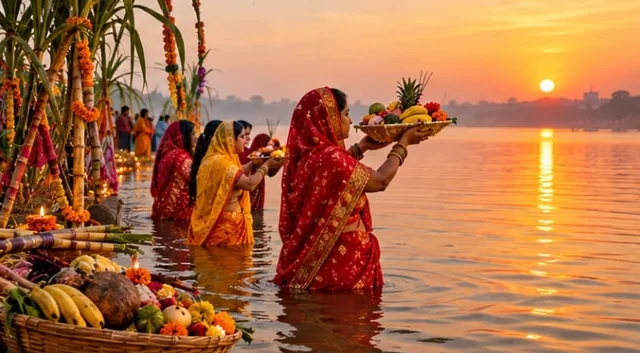
Chhath is the four-day worship of Surya and Chhathi Maiya, kept with great discipline in Bihar, Jharkhand, eastern Uttar Pradesh and the Terai of Nepal, and wherever families from these regions live. Devotees, called vratis, keep a long nirjala fast and offer arghya to the setting and the rising sun while standing in a river or pond.
The vrat is known for its discipline: the main fast after Kharna lasts about 36 hours without water, and the prasad is prepared with great care, often on a new clay stove with mango wood. It is one of the few Hindu festivals where the setting sun is worshipped as well as the rising sun.
The Chhath katha in brief
Chhath is dedicated to Surya Dev and Chhathi Maiya — remembered in tradition as the sixth portion (shashthi ansh) of Prakriti, the divine Devi Shashthi (Devasena), the mind-born daughter of Brahma ji and the protectress of children. The principal katha, as told in the Puranas, is of King Priyavrat and Queen Malini, who had no child. On the advice of Rishi Kashyap they performed the Putrakameshti yagya, and a son was born to them — but the child was born lifeless, and the palace drowned in grief. Then, in a divine chariot, Chhathi Maiya appeared; with her divine touch the infant came to life. From that day, tradition says, the worship of Shashthi began.
Other cherished associations are kept as “parampara me kaha jata hai”: that Surya's son Karna would stand in the river every morning offering arghya to the Sun; that Draupadi kept Surya-upasana during the exile; and that in some traditions Ram and Sita, on returning from exile, worshipped Shashthi and the Sun. The four-day discipline of Chhath — Nahay-Khay, Kharna, the evening arghya to the setting sun, and the morning arghya to the rising sun — is kept with gratitude to the Sun who gives life to all.
Who Is Chhathi Maiya? The Goddess of Chhath
Chhath is offered to two divine powers together — Surya Dev, who gives light, energy and life, and Chhathi Maiya, the mother who protects that life. Without her, the Chhath vrat is considered incomplete.
Who she is
Chhathi Maiya is Devi Shashthi (Shashthi Devi). In the Puranas she is described as the mind-born daughter (manas-putri) of Brahma, manifested from the sixth portion of Prakriti, primordial nature. That is why she is called "Shashthi" — the Sixth. She is also known as Devasena, and the Puranas name her as the consort of Kartikeya. In some traditions she is linked with Devi Katyayani, who is worshipped on the sixth day (Shashthi) of Navratri.
Surya's sister
In the living folk tradition of Bihar, Jharkhand, eastern Uttar Pradesh and the Nepal Terai, Chhathi Maiya is lovingly regarded as the sister of Surya Dev. The Puranas give her identity as Shashthi Devi; the bond of brother and sister is the gift of the folk tradition. Devotees believe that worshipping the sister pleases the brother — so on Chhath, arghya is offered to Surya while the heart's prayer is placed before his sister, and her grace carries Surya's blessings into the home.
The protector of children
Above everything, Chhathi Maiya is the guardian of children. She is believed to watch over newborns from birth, grant children long life, health and strength, and bless childless couples with progeny. This is why, in so many Indian families, a baby's sixth-day ceremony is itself called "chhathi" — on that day Shashthi Devi is invoked to take the child under her protection, and in the old belief she stays near the child through the first six days of life.
The Priyavrat katha
The most loved katha of Chhathi Maiya comes from the Brahmavaivarta Purana (the same story appears in the Devi Bhagavata). King Priyavrat, son of Swayambhuva Manu, and his queen Malini were childless for long. When at last a son was born to them, the child was stillborn, and the heartbroken king carried him to the cremation ground. There, on Kartik Shukla Shashthi, Shashthi Devi appeared in a divine chariot, took the child in her lap and restored him to life. She declared that she is the protector of children, and King Priyavrat established her worship — the tradition from which Chhath is said to have begun.
More traditions of her worship
The Mahabharata tradition remembers that Devmata Aditi worshipped Chhathi Maiya (Ranbe) praying for a radiant son, and was blessed. The Pandavas' priest Dhaumya is said to have advised Draupadi to keep the Surya–Shashthi vrat, after which the Pandavas regained their fortune. Karna, the son of Surya, is remembered as a devoted keeper of the arghya ritual, standing in the river to offer water to the rising sun. In the folk tradition of Munger, Sita is also remembered as having offered Chhath after returning to Ayodhya. These are remembered as traditions and kathas, each told with love in its own region.
Her vahan — the cat
Chhathi Maiya's vahan (vehicle) is the cat. In the Chhath region this is a living custom: during the festival days, families offer food and milk to cats in honour of the Maiya's vahan, and a cat is never turned away hungry from a vrati's home.
Her form
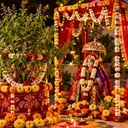
The scriptures describe her as a gentle, motherly goddess with a golden glow, often shown holding a child protectively in her lap — the picture of a mother who guards every child as her own. Unlike most goddesses, she is rarely worshipped through idols and temples. She is met in nature and in light itself: many devotees see her in Usha, the first light of morning, and Pratyusha, the last light of evening — the very two moments at which Chhath arghya is offered.
Where she is present
Her place is wherever the vrat is kept — the river and pond ghats where devotees stand waist-deep in water, the shade of banana and sugarcane groves, and the home courtyard where the soop and daura are prepared. During the four days of Chhath she is invoked at every step: in the purity of Nahay-Khay, in the kheer of Kharna shared as her prasad, and above all in the two arghyas — Sandhya Arghya to the setting sun and Usha Arghya to the rising sun.
Why devotees pray to her on Chhath
For the protection and long life of their children. For the gift of a child. For health, recovery and the removal of troubles from the family. And for prosperity that stays — because the mother who guards life itself is pleased. The vrat is most often kept by mothers, but fathers and elders keep it too, for the whole family.
Her names across regions
In Mithila she is Ranbe May; in the Bhojpuri region, Sabita Mai; in Bengal, Ranbe Thakur; and everywhere she is simply "Chhathi Maiya" — the mother of the sixth day.
Puja samagri
- Bamboo soop (winnowing trays) and a daura or dauri (bamboo basket) for each vrati
- Thekua, rice laddoos (kasar) and the seasonal fruit of the region: banana, sugarcane, coconut, citrus, singhara, sweet lime, radish and ginger plants
- A new set of clothes for the vrati, sindoor, a ghee diya and incense
- A brass or copper lota, or a glass of milk, for the arghya
- Sugarcane stalks to make a canopy at home or at the ghat
How the four days are kept
- Nahay Khay (2 November): the vrati bathes in a river or at home, cleans the house, and eats one sattvik meal of rice, chana dal and lauki cooked without onion or garlic.
- Kharna (3 November): a fast through the day, broken after sunset with rasiya (gur kheer) and roti offered first to Chhathi Maiya and then shared. The 36-hour nirjala fast begins after this meal.
- Sandhya Arghya (4 November): the family carries the daura to the ghat in the afternoon. Standing in the water, the vrati offers arghya of milk or water to the setting sun with the soop of prasad.
- Usha Arghya (5 November): the family returns to the ghat before dawn, sings Chhath geet, and offers arghya to the rising sun. The vrati breaks the fast with prasad and a little ginger and water.
Mantra
Surya arghya mantra
ॐ एहि सूर्य सहस्रांशो तेजोराशे जगत्पते।
अनुकम्पय मां भक्त्या गृहाणार्घ्यं दिवाकर॥
Om ehi Surya sahasramsho tejorashe jagatpate,
anukampaya mam bhaktya grihanarghyam divakara.
"O Surya of a thousand rays, store of light and lord of the world, accept this arghya offered with devotion."
Date and timing for 2027
All 2027 festivals, vrats, Purnima, Amavasya and Sangrand dates are in our 2027 festival calendar.
Questions about Chhath Puja 2027
When is Chhath Puja in 2027?
Chhath Puja 2027 runs from Tuesday 2 to Friday 5 November. The main day, with the evening arghya, is Thursday, 4 November.
What are the four days of Chhath 2027?
Nahay Khay on 2 November, Kharna on 3 November, Sandhya Arghya on 4 November and Usha Arghya with parana on 5 November.
What is the Sandhya Arghya time on 4 November 2027?
Arghya is offered to the setting sun. Sunset is around 5:06 PM in Patna and 5:34 PM in New Delhi on 4 November.
What is the Usha Arghya time on 5 November 2027?
Arghya is offered at sunrise on 5 November: around 5:59 AM in Patna and 6:35 AM in New Delhi.
When does Shashthi tithi begin and end?
Shashthi tithi begins at 7:31 PM on 3 November and ends at 9:37 PM on 4 November 2027 (New Delhi, IST).
Who is Chhathi Maiya?
Chhathi Maiya is Devi Shashthi (Shashthi Devi). In the Puranas she is described as the mind-born daughter (manas-putri) of Brahma, manifested from the sixth portion of Prakriti, primordial nature. That is why she is called "Shashthi" — the Sixth. In the living folk tradition of Bihar, Jharkhand, eastern Uttar Pradesh and the Nepal Terai, she is lovingly regarded as the sister of Surya Dev.
What is Chhathi Maiya's vahan?
Chhathi Maiya's vahan (vehicle) is the cat. In the Chhath region this is a living custom: during the festival days, families offer food and milk to cats in honour of the Maiya's vahan, and a cat is never turned away hungry from a vrati's home.
Why is Chhathi Maiya worshipped on Chhath?
Chhath is offered to two divine powers together — Surya Dev, who gives light, energy and life, and Chhathi Maiya, the mother who protects that life. Without her, the Chhath vrat is considered incomplete. For the protection and long life of their children. For the gift of a child. For health, recovery and the removal of troubles from the family. And for prosperity that stays — because the mother who guards life itself is pleased.
Festival customs vary by region and family. Follow the practice of your own family and temple where it differs from what is written here.