- Date in 2027
- Friday, 15 January
- Sankranti time
- About 9:10 PM, 14 January (IST)
- Marks
- The sun entering Makara (Capricorn)
- Lohri
- Thursday, 14 January 2027 — evening, the night before
- Pongal
- 14–17 January 2027, Thai Pongal on 15 January
- Punya kaal
- 7:15 AM – 5:46 PM, 15 January (New Delhi)
What is Makar Sankranti?
Makar Sankranti is the day the sun moves into the sidereal sign of Makara (Capricorn). Most Hindu festivals follow the moon, but this one follows the sun, which is why it falls on almost the same date every year, usually 14 or 15 January. It is traditionally celebrated as the beginning of Uttarayan, the sun's journey towards the north, and the start of brighter, warmer days. In the Mahabharata, Bhishma waits on his bed of arrows for Uttarayan before leaving his body.
The day has a different name and flavour almost everywhere in India: Uttarayan in Gujarat, Khichdi in Uttar Pradesh and Bihar, Poush Sankranti in Bengal, Magh Bihu in Assam, Pongal in Tamil Nadu, and Maghi in Punjab, where it follows the Lohri bonfire of the night before.
How it is celebrated
- Holy dip and charity: a bath in a river at sunrise, arghya to the sun, and gifts of til, jaggery, khichdi, blankets and warm clothes. Lakhs of pilgrims bathe at Gangasagar in Bengal and at the Sangam in Prayagraj.
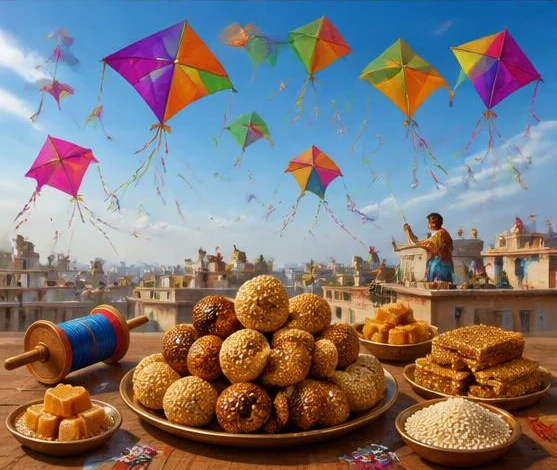
- Til and gud: sesame and jaggery, warming foods for the coldest weeks, are made into laddoos and chikki. In Maharashtra people exchange tilgul with the words "tilgul ghya, god god bola", "take this sweet and speak sweetly".
- Kites: in Gujarat and Rajasthan the sky fills with kites from early morning, and rooftop kite battles go on until dark.
- Khichdi and dahi-chura: in Uttar Pradesh and Bihar the day is often simply called Khichdi, and families eat khichdi, or flattened rice with curd and jaggery.
- Magh Bihu: in Assam communities build a meji, a bonfire hut, feast through the night and light it at dawn.
Puja on Makar Sankranti
Puja samagri
- A copper lota of water with a pinch of til, red flowers and akshat for the arghya
- Til, jaggery and khichdi ingredients (rice and dal) for daan
- A ghee diya and incense
Puja vidhi
- Bathe early, in a river if you can, or at home with a little til in the water.
- Facing the rising sun, offer water from the lota as arghya, chanting a Surya mantra.
- Offer til-gud and khichdi to the household deities and to the sun.
- Give til, jaggery, uncooked khichdi, blankets or warm clothes to people who need them.
- Share til sweets with family and neighbours.
Mantra
Surya mantra
ॐ घृणि सूर्याय नमः॥
Om Ghrini Suryaya Namah.
A short mantra to the sun, chanted while offering arghya.
Lohri: the bonfire night before Sankranti
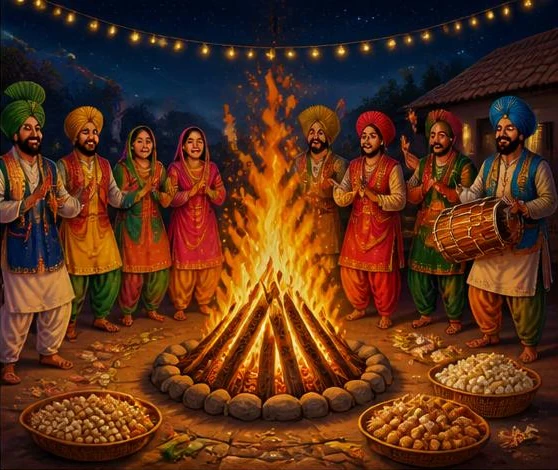
Lohri is celebrated on the night before Makar Sankranti, mostly in Punjab, Haryana, Delhi, Himachal Pradesh and Jammu. It marks the end of the coldest part of winter and is a thanksgiving for the rabi crop, especially sugarcane and wheat. After sunset families and neighbours gather around a large bonfire, walk around it and throw in til, gur, rewari, peanuts and popcorn, then share the same foods with everyone present.
Children go from house to house in the days before, singing Lohri songs and collecting treats. The best known of these songs remembers Dulla Bhatti, a Punjabi hero of Akbar's time who, the story goes, rescued poor girls and arranged their weddings. The first Lohri of a new bride or a newborn baby is celebrated with special warmth, with dhol, bhangra and giddha around the fire.
Pongal: four days of harvest in Tamil Nadu
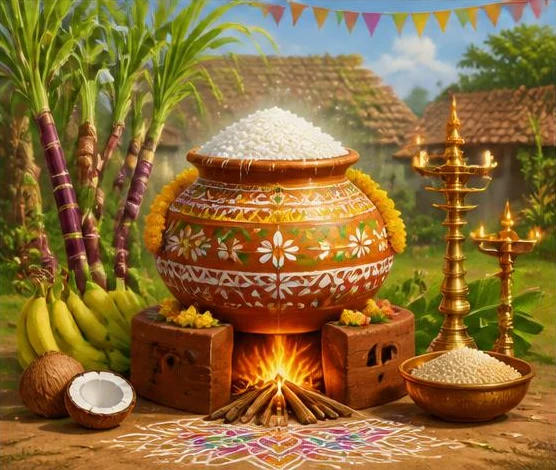
Pongal begins the Tamil month of Thai and is celebrated over four days. The name means "to boil over", and the heart of the festival is a pot of new rice, milk and jaggery cooked outdoors until it spills over the rim, when the family calls out "Pongalo Pongal!" for a year of plenty.
- Bhogi: the last day of Margazhi. Homes are cleaned, old things are discarded, and in some places a small bonfire is lit.
- Thai Pongal (Surya Pongal): the main day. Rice is boiled in a new pot tied with a fresh turmeric plant and decorated with kolam, then offered to Surya with sugarcane and bananas. Sweet sakkarai pongal and savoury ven pongal are made.
- Mattu Pongal: cattle are bathed, their horns painted and garlanded, and they are thanked for their work. Jallikattu is held in many villages.
- Kaanum Pongal: a day for visiting family, outings and picnics.
Dates and timings for 2027
In 2027 the sun enters Makara after sunset on 14 January, so most panchangs keep Makar Sankranti, the holy dip and the daan on the morning of Friday, 15 January. A few calendars still print 14 January. In Punjab the SGPC calendar keeps Maghi (1 Magh) on 14 January, and Lohri is lit on Thursday, 14 January 2027 — evening, the night before Makar Sankranti.
Timings are for New Delhi (IST). Checked against Tirth.com, AstroSage (New Delhi), Astrovachmi, Officeholidays and the SGPC calendar. Punya kaal and maha punya kaal as given by Drik Panchang for New Delhi.
All 2027 festivals, vrats, Purnima, Amavasya and Sangrand dates are in our 2027 festival calendar.
Questions about Makar Sankranti, Lohri and Pongal
When is Makar Sankranti in 2027?
On Friday, 15 January 2027. The sun enters Makara at about 9:10 PM (IST) on 14 January, after sunset, so the holy dip and daan are kept on the morning of the 15th. Lohri is on Thursday, 14 January 2027 — evening, and Thai Pongal is also on 15 January.
Why is til-gud eaten on Makar Sankranti?
Sesame and jaggery are warming foods for the coldest weeks of the year, and sharing them is a way of starting the new season on sweet terms. That is the idea behind the Marathi greeting "tilgul ghya, god god bola".
Are Lohri and Makar Sankranti the same festival?
No. Lohri is the bonfire night before Makar Sankranti, celebrated mainly in Punjab and neighbouring states. The next day, Makar Sankranti, is kept as Maghi in Punjab.
What are the four days of Pongal?
Bhogi, Thai Pongal (also called Surya Pongal), Mattu Pongal for the cattle, and Kaanum Pongal for visiting family.
Festival customs vary by region and family. Follow the practice of your own family and temple where it differs from what is written here.