- Tulsi Vivah 2026
- Saturday, 21 November
- Ekadashi tithi
- 7:15 AM, 20 Nov – 6:31 AM, 21 Nov
- Dwadashi tithi
- 6:31 AM, 21 Nov – 4:56 AM, 22 Nov
- In 2027
- Thursday, 11 November
About Tulsi Vivah
In 2027: Tulsi Vivah falls on Thursday, 11 November (Kartik Shukla Dwadashi).
Tulsi Vivah is the ceremonial marriage of the tulsi plant, worshipped as Goddess Vrinda, to Lord Vishnu in his Shaligram form or to Krishna. It follows Prabodhini (Dev Uthani) Ekadashi, when Lord Vishnu is said to wake from his four-month sleep, and it marks the start of the wedding season.
In 2026 Ekadashi runs from 7:15 AM on 20 November to early morning on 21 November, and Dwadashi is the tithi at sunrise on Saturday, 21 November, the day used for Tulsi Vivah here. The tulsi pot is decorated like a bride with a red chunri and bangles, a sugarcane mandap is built over it, and the wedding is completed with mantras, pheras and prasad.
The Tulsi Vivah katha in brief
Tulsi Vivah celebrates the divine wedding of Maa Tulsi with Lord Vishnu in his Shaligram form. Behind it stands the story of Vrinda and Jalandhar. Jalandhar was born from the radiance of Lord Shiva's third eye falling into the ocean; raised by Samudra and named by Brahma ji, he carried Shiva's own ansh (portion) within him — which is why the gods' weapons could not touch him. He was married to Vrinda, the daughter of Kalanemi and a supreme devotee of Vishnu, whose vrat and devotion formed a shield of light around her husband. In his arrogance, Jalandhar once went so far as to approach Maa Parvati in disguise — and the Goddess saw through him.
The gods then sought Vishnu's help: in open battle Jalandhar could not be defeated while Vrinda's vow stood unbroken. At the gods' earnest plea, Vishnu took the form of a wandering sage, and through this divine leela Vrinda's patrivrat vow was broken (this part of the story is told in one respectful line, as tradition hands it down). The moment the shield fell, Jalandhar's powers ended, and Shiva's trident brought his story to a close; his radiance merged back into Shiva.
In her grief, Vrinda cursed Vishnu to become stone — and Vishnu accepted it with complete humility: that stone is the sacred Shaligram. As Vrinda departed like a divine flame, Vishnu blessed her with the words devotees still remember: “For your devotion and truth, you have become dearer to me than Lakshmi herself. You will now live as Tulsi, forever near me, and your wedding with my Shaligram form will be celebrated every year — without Tulsi, my worship will remain incomplete.” From that day, Tulsi is offered in every Vishnu puja, and Kartik's Tulsi Vivah rejoices in that promise.
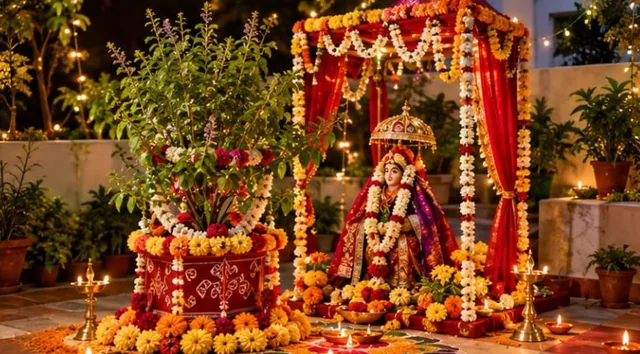
Puja samagri
- The tulsi plant in its pot, cleaned and placed on a decorated platform
- A Shaligram stone or a small idol of Vishnu or Krishna as the groom
- Sugarcane stalks to make the mandap, and a red chunri, bangles, bindi and sindoor for the tulsi
- Roli, haldi, akshat, flowers, a ghee diya, incense, fruit, sweets and amla
Puja vidhi
- In the evening, build a small mandap of sugarcane over the tulsi pot and decorate it with flowers.
- Dress the tulsi as a bride with the red chunri and shringar, and place the Shaligram or Vishnu idol beside her.
- Worship both with haldi, roli, akshat and flowers, and offer fruit and sweets.
- Tie the two together with a thread or a cloth, and carry the Shaligram around the tulsi seven times for the pheras while mangal geet are sung.
- End with the aarti and share the prasad. The wedding season begins after this day.
Mantras
To wake Lord Vishnu (Dev Uthani Ekadashi)
उत्तिष्ठ गोविन्द त्यज निद्रां जगत्पते।
त्वयि सुप्ते जगन्नाथ जगत् सुप्तं भवेदिदम्॥
Uttishtha Govinda tyaja nidram jagatpate,
tvayi supte jagannatha jagat suptam bhaved idam.
"Rise, Govinda, leave your sleep, lord of the world: while you sleep, the whole world sleeps."
Tulsi mantra
वृन्दा वृन्दावनी विश्वपूजिता विश्वपावनी।
पुष्पसारा नन्दनीय तुलसी कृष्णजीवनी॥
Vrinda Vrindavani Vishvapujita Vishvapavani,
Pushpasara Nandaniya Tulasi Krishnajivani.
The eight names of Tulsi, recited while circling the plant.
Date and timing for 2026
Every festival and vrat of the month is on our November 2026 festivals page.
All 2026 festivals, vrats, Purnima, Amavasya and Sangrand dates are in our 2026 festival calendar.
Questions about Tulsi Vivah
When is Tulsi Vivah in 2026?
On Saturday, 21 November 2026, when Kartik Shukla Dwadashi is the tithi at sunrise.
When is Tulsi Vivah in 2027?
On Thursday, 11 November 2027 (Kartik Shukla Dwadashi).
When is Dev Uthani Ekadashi in 2026?
On Friday, 20 November 2026. Ekadashi tithi runs from 7:15 AM on 20 November to 6:31 AM on 21 November, and the fast is broken the next morning, during Dwadashi.
Festival customs vary by region and family. Follow the practice of your own family and temple where it differs from what is written here.