- Date
- Wednesday, 25 August 2027
- Nishita puja (New Delhi)
- 12:01–12:45 AM, night of 25–26 August
- Tithi
- Bhadrapada Krishna Ashtami
- Central Government holiday
- Wednesday, 25 August
- Dahi Handi
- Thursday, 26 August
The birth of Krishna
Lord Krishna, the eighth avatar of Vishnu, was born at midnight on the Ashtami of the dark half of Bhadrapada, under the Rohini nakshatra. His mother Devaki and father Vasudeva were in the prison of her brother Kamsa, the king of Mathura, who had been told that Devaki's eighth son would kill him and had killed each of her children at birth.
When Krishna was born, the guards fell asleep and the prison doors opened. Vasudeva carried the baby across the Yamuna in a basket through the storm, with the serpent Shesha spreading his hoods over them, to Gokul, where he left him with Nanda and Yashoda and brought back their newborn daughter. Krishna grew up in Gokul and Vrindavan as the butter-stealing child and cowherd boy whose leelas are sung at Janmashtami, and later returned to Mathura to end Kamsa's rule.
Why Janmashtami is on 25 August in 2027
Janmashtami is decided by the Ashtami tithi and the Rohini nakshatra at midnight, the moment of Krishna's birth. In 2027 the Ashtami begins at 8:24 PM on 24 August and ends at 7:19 PM on 25 August, and the Rohini nakshatra runs from 12:27 PM on 25 August to 11:42 AM on 26 August.
- Wednesday, 25 August has the Ashtami at sunrise and the Rohini nakshatra at midnight. Drik Panchang keeps Janmashtami on this day for New Delhi, both for households and for ISKCON.
- The Nishita (midnight) puja is from 12:01 AM to 12:45 AM on the night of 25–26 August in New Delhi.
- The Central Government's 2027 holiday list also has Janmashtami on Wednesday, 25 August, and Dahi Handi in Maharashtra is the next day, Thursday, 26 August.
Temples in Mathura and Vrindavan announce their own programme each year, so check locally if you plan to visit.
The Janmashtami fast and midnight puja
Puja samagri
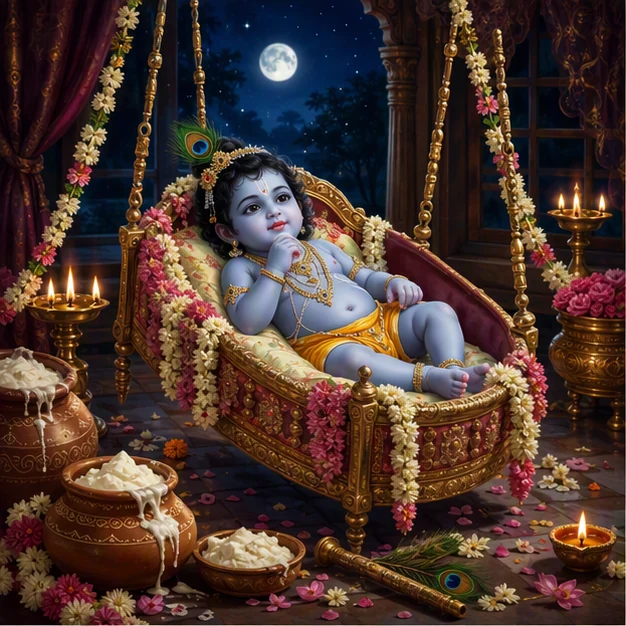
- An idol of Laddu Gopal (Bal Krishna) and a small cradle (jhula), decorated with flowers
- New clothes, a crown, a flute and a peacock feather for the idol
- Panchamrit (milk, curd, ghee, honey and sugar) and Ganga jal for the abhishek
- Tulsi leaves, flowers, sandalwood, a ghee lamp and incense
- Bhog: makhan-mishri, panjiri of coriander seed, fruit, and kheer or sweets
Vrat and puja vidhi
- Take the sankalp in the morning. Keep the fast as your family does: on fruit and milk (phalahar), on water, or without water. Grain is not eaten.
- Decorate the puja place and the cradle, and spend the day in bhajan and kirtan, or reading the Bhagavata story of Krishna's birth.
- Before midnight, bathe the idol with panchamrit and Ganga jal, dress and adorn him, and place him in the cradle.
- At midnight, the moment of birth, ring the bell and blow the conch, rock the cradle and do the aarti. Offer the bhog with tulsi leaves.
- Many break the fast after the midnight puja with the prasad; others, following a stricter rule, break it the next day after the Ashtami ends, as their panchang says.
Krishna mantra
कृष्णाय वासुदेवाय हरये परमात्मने।
प्रणतक्लेशनाशाय गोविन्दाय नमो नमः॥
Krishnaya Vasudevaya Haraye Paramatmane,
pranata klesha nashaya Govindaya namo namah.
"Salutations again and again to Krishna, son of Vasudeva, Hari, the Supreme Self, Govinda, who takes away the sorrows of those who bow to him."
"Om Namo Bhagavate Vasudevaya" and the Hare Krishna mahamantra are also chanted through the day.
Children, the elderly, pregnant women and anyone with a health condition can keep the vrat with fruit and milk; the bhajan and the midnight puja are the heart of the day.
Jhankis, Dahi Handi and Nand Utsav
- Jhankis and swings: temples and homes set up tableaux of Krishna's life and decorate swings for Laddu Gopal. Children dress as Krishna and Radha.
- Dahi Handi: in Maharashtra and Goa (Gopalkala), teams of young men, the govindas, build human pyramids to break a pot of curd hung high above the street, as Krishna and his friends broke the pots of the gopis.
- Nand Utsav: the day after the birth, Mathura, Vrindavan and Gokul celebrate Nanda's joy at his son's birth with songs, sweets and the sprinkling of curd and turmeric.
- Across India: Gujarat celebrates with the Satam-Atham week and Dwarka's temple at midnight; in Tamil Nadu and Kerala, Gokulashtami homes draw small footprints from the door to the puja room, as if the baby Krishna has walked in; Manipur celebrates with Raslila.
Dates and timings for 2027
Drik Panchang keeps Janmashtami on 25 August, the day with the Ashtami at sunrise and the Rohini nakshatra at midnight. The Rohini nakshatra runs from 12:27 PM on 25 August to 11:42 AM on 26 August.
Timings are for New Delhi (IST). The date and the Nishita puja time are from Drik Panchang, checked against our own calculation and other published 2027 panchangs; the Central Government's 2027 holiday list gives the same date. Ashtami and Rohini times: Prokerala and drrpsharma.com agree to within a minute.
Every festival and vrat of the month, with Pradosh, Sangrand, Purnima and Amavasya, is on our August 2027 festivals page.
All 2027 festivals, vrats, Purnima, Amavasya and Sangrand dates are in our 2027 festival calendar.
Questions about Krishna Janmashtami
When is Janmashtami in 2027?
On Wednesday, 25 August 2027. The Ashtami runs from 8:24 PM on 24 August to 7:19 PM on 25 August, and the midnight puja in New Delhi is from 12:01 to 12:45 AM.
Which day should I keep the Janmashtami fast?
On Wednesday, 25 August 2027, with the puja at midnight. If your family or temple follows a different panchang, keep the day it announces.
What can I eat during the Janmashtami fast?
Those keeping phalahar eat fruit, milk, curd, makhana, and dishes of kuttu or singhara flour, sabudana and potatoes with rock salt. Grain, onion and garlic are avoided.
When is the Janmashtami fast broken?
Many break it after the midnight puja with the prasad. Those who follow the stricter rule break it the next day after the Ashtami and Rohini nakshatra have ended, at the time their panchang gives.
When is Dahi Handi in 2027?
On Thursday, 26 August 2027 in Maharashtra, the day after Janmashtami.
Festival customs vary by region and family. Follow the practice of your own family and temple where it differs from what is written here.