Shardiya Navratri 2026
Navratri 2026: what it is and how it is celebrated
Shardiya Navratri falls in the bright half of Ashwin. In 2026 it runs from Sunday 11 October to Monday 19 October, with Vijayadashami on Tuesday 20 October.
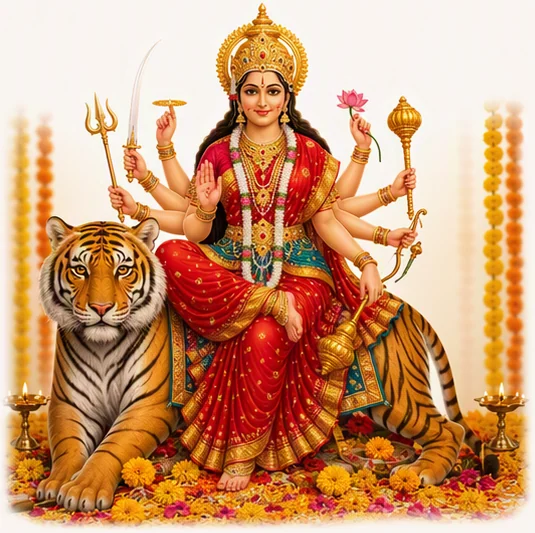
What is Shardiya Navratri?
Navratri means "nine nights". It is celebrated several times a year, but the autumn festival in the month of Ashwin, called Shardiya Navratri, is the one most of India knows. For nine nights the Goddess is worshipped in her nine forms, the Navadurga, one form on each day.
The best-known story behind the festival is from the Devi Mahatmya. The buffalo demon Mahishasura could not be defeated by any god, so the energies of the gods came together as Maa Durga. She fought him for nine days and killed him on the tenth, which is why the tenth day is called Vijayadashami, "the tenth day of victory". The same day also marks Lord Rama's victory over Ravana.
Navratri 2026 at a glance
| Date | Observance | Notes |
|---|---|---|
| Sat, 10 Oct | Mahalaya / Sarva Pitru Amavasya | End of Pitru Paksha; in Bengal, the invocation of the Goddess |
| Sun, 11 Oct | Ghatasthapana, Day 1 | Muhurat 6:19 AM – 10:11 AM |
| Fri, 16 Oct | Maha Shashthi | Durga Puja begins in Bengal: Bilva Nimantran in the evening, Bodhon on 17 Oct |
| Mon, 19 Oct | Durga Ashtami, Sandhi Puja, Maha Navami | Sandhi Puja 10:28 AM – 11:16 AM; Kanya Pujan |
| Tue, 20 Oct | Vijayadashami (Dussehra) | Vijay Muhurat 1:59 PM – 2:44 PM; Ravan Dahan after sunset |
| Wed, 21 Oct | Bijoya Dashami in Bengal | Sindoor Khela and Durga Visarjan |
For tithi, sunrise, moonrise and Rahu Kaal on every day, see the day-by-day panchang.
How India celebrates
- North India: homes set up a kalash and khetri, many people fast, Ramlila plays are staged, and Kanya Pujan is done on Ashtami or Navami.
- Gujarat and western India: every night is for Garba and Dandiya Raas around the garbo lamp. Read the Garba and Dandiya guide.
- Bengal, Odisha and Assam: the last five days are Durga Puja, with pandals, Sandhi Puja, Sindoor Khela and immersion.
- South India: families arrange Golu (Bommai Kolu) dolls, and Navami is Ayudha Puja and Saraswati Puja. Vijayadashami is a day to begin learning (Vidyarambham).
Navratri fasting
Fasting is a personal choice. Some people fast all nine days, some only on the first and last day, and some take one meal a day. Common rules for the vrat are:
- Grains like wheat and rice, pulses, onion and garlic are avoided.
- Kuttu (buckwheat), singhara (water chestnut), rajgira and samak rice are used instead of regular flour and rice.
- Sendha namak (rock salt) is used in place of regular salt.
- Fruit, milk, curd, paneer, makhana, potatoes, sweet potatoes and nuts are allowed.
Drink plenty of water, and if you have a health condition, are pregnant or take regular medicine, check with your doctor before a long fast. The fast is usually broken (parana) after Navami or on Dashami, following your family custom.
See the prasad page for simple vrat food and the bhog for each Devi.