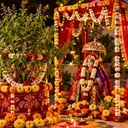
- Date in 2027
- Friday, 14 May
- Tithi
- Vaishakha Shukla Navami, at midday
- Madhyahna muhurat (New Delhi)
- 10:56 AM – 1:39 PM
- Also called
- Janaki Jayanti, Janaki Navami
- Associated places
- Sitamarhi (Bihar), Janakpur (Nepal)
- Exactly one month after
- Ram Navami, 15 April 2027
The story of Sita's birth
King Janaka of Mithila was ploughing a field as part of a yajna when the tip of his plough struck a golden casket in the earth. Inside lay a baby girl. Janaka raised her as his daughter and named her Sita, after sita, the furrow made by the plough. She is also called Janaki, daughter of Janaka, Vaidehi and Maithili, and is revered as an avatar of Goddess Lakshmi and as Bhumija, the daughter of the earth.
Sita Navami falls in the bright half of Vaishakha, a month after Ram Navami, and like it is kept at midday. Sitamarhi in Bihar, with the Punaura Dham temple, is honoured as the place where she was found, and the Janaki Mandir at Janakpur in Nepal holds one of the biggest celebrations. In parts of western and southern India, Sita's appearance is also remembered on Phalgun Krishna Ashtami, as Janaki Jayanti.
Sita Navami puja vidhi
Puja samagri
- Pictures or idols of Sita and Rama, or of the Ram Darbar
- A small mandap or decorated seat with a red cloth
- Red flowers, roli, akshat, sandalwood and a ghee lamp
- Shringar items for Mata Sita: bangles, sindoor, bindi, a red chunri
- Fruit, panchamrit and sweets for naivedya
- Tulsi leaves for Lord Rama
Puja vidhi
- Bathe in the morning and take a sankalp to keep the fast. Many married women keep it for the long life of their husbands and the happiness of the family.
- At midday, the time of Sita's appearance, set the pictures on the decorated seat, Sita to the left of Rama.
- Worship Ganesh first, then offer roli, akshat, flowers and the shringar items to Mata Sita and tulsi to Lord Rama.
- Offer the naivedya, recite the Sita verse or "Shri Sita Ramabhyam Namah", and end with the aarti.
- Break the fast in the evening or the next morning, as your family does, and give food or clothes to a married woman or to someone in need.
Verse to Mata Sita from the Ramcharitmanas
उद्भवस्थितिसंहारकारिणीं क्लेशहारिणीम्।
सर्वश्रेयस्करीं सीतां नतोऽहं रामवल्लभाम्॥
Udbhava-sthiti-samhara-karinim klesha-harinim,
sarva-shreyaskarim Sitam nato'ham Rama-vallabham.
From the opening of the Ramcharitmanas: "I bow to Sita, beloved of Rama, who brings about creation, preservation and dissolution, who removes all suffering and gives every blessing."
Name mantra
श्री सीतारामाभ्यां नमः॥
Shri Sita-Ramabhyam Namah.
Why Sita is remembered
Sita is remembered for her strength more than her suffering: she chose to follow Rama into fourteen years of exile, held firm through her captivity in Lanka, and in the Uttara Kanda raised her sons Lava and Kusha alone in the ashram of the sage Valmiki. For many families Sita Navami is a day to honour the women of the household, and in Mithila it is celebrated with songs, fairs and the retelling of Sita's life.
Dates and timings for 2027
The Sita Navami puja is done at madhyahna, the middle of the day. In New Delhi the madhyahna muhurat on 14 May is 10:56 AM to 1:39 PM.
Timings are for New Delhi (IST). Checked against Tirth.com, BhaktiBharat and our own tithi calculation.
Every festival and vrat of the month, with Pradosh, Sangrand, Purnima and Amavasya, is on our May 2027 festivals page.
All 2027 festivals, vrats, Purnima, Amavasya and Sangrand dates are in our 2027 festival calendar.
Questions about Sita Navami
When is Sita Navami in 2027?
On Friday, 14 May 2027. Vaishakha Shukla Navami runs from 9:17 PM on 13 May to 7:39 PM on 14 May, so it covers midday on the 14th, the time of Sita's appearance.
Why is Sita Navami celebrated at midday?
Like Rama, Sita is said to have appeared at midday, so the puja is done in the madhyahna, the middle part of the day.
Who keeps the Sita Navami fast?
Mostly married women, for the long life of their husbands and the well-being of the family, though anyone devoted to Sita and Rama may keep it.
Is there another Janaki Jayanti?
Yes. In parts of western and southern India, Janaki Jayanti is kept on Phalgun Krishna Ashtami. Vaishakha Shukla Navami is the more widely observed date in North India and Nepal.
Festival customs vary by region and family. Follow the practice of your own family and temple where it differs from what is written here.