- Hariyali Teej 2027
- Wednesday, 4 August
- Kajari Teej 2027
- Friday, 20 August
- Hartalika Teej 2027
- Friday, 3 September
- Worship of
- Goddess Parvati and Lord Shiva
- Kept mostly by
- Married women, and girls praying for a good husband
The three Teej of the monsoon
Teej comes from tritiya, the third day of the lunar fortnight. Three Tritiyas of the rainy season are kept as Teej, each in honour of Goddess Parvati, who is said to have won Lord Shiva as her husband after long years of penance. Married women keep the Teej fasts for a long and happy married life, and unmarried girls keep them hoping for a husband as devoted as Shiva.
The festival belongs above all to Rajasthan, Haryana, Uttar Pradesh, Bihar, Madhya Pradesh and the plains of Nepal, and every region has its own songs and sweets. The names can be confusing: Hariyali Teej is also called Shravani Teej or Choti Teej, and Kajari Teej is known in Rajasthan as Badi Teej or Satudi Teej.
Hariyali Teej: Wednesday, 4 August
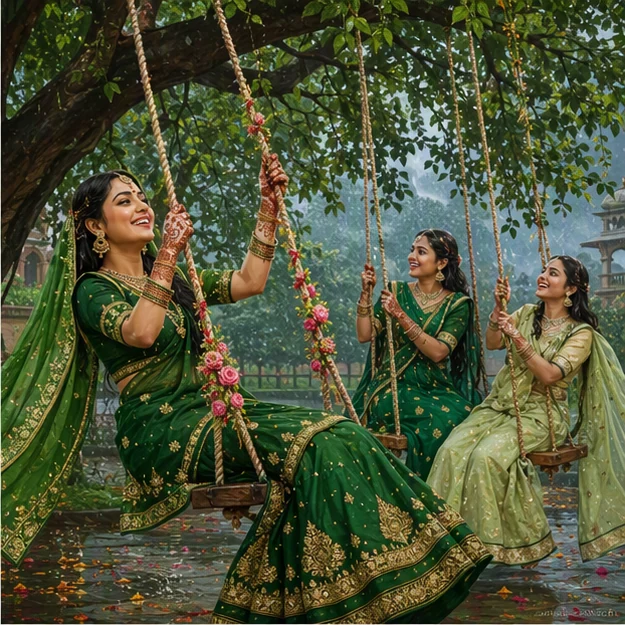
Hariyali Teej comes in the middle of Sawan, when the fields are green and the first rains have filled the ponds. Hariyali means greenery, and green is the colour of the day: women wear green saris and lehengas and fill their wrists with green glass bangles. Swings are hung from neem and mango trees and decorated with flowers, and women swing in turns, singing the songs of Sawan.
The evening before, hands are covered in mehndi. Parents send their married daughters a sindhara (or shrinjhara): new clothes, bangles, henna, and sweets such as ghevar. On the day itself most women fast, many without water, and gather in the evening for the puja of Parvati and Shiva and the reading of the Teej katha. In Jaipur, an idol of Teej Mata is carried from the City Palace in a royal procession.
More in our Hariyali Teej guide.
Kajari Teej: Friday, 20 August
Kajari Teej falls fifteen days after Hariyali Teej, on the third day of the dark half of Bhadrapada. It takes its name from kajari, the rain songs of Mirzapur, Varanasi and the Bhojpuri country, which women sing through the evening in groups. In Rajasthan the day is Badi Teej or Satudi Teej: laddoos of sattu (roasted gram or barley flour) are made and offered, and many families worship Neemdi Mata, a branch of neem set beside a small pool of water. Bundi holds a well-known Kajli Teej fair.
The fast is kept through the day and broken at night after the women offer water to the moon. In 2027 the moon rises in New Delhi at 8:27 PM. The same night is also Sankashti Chaturthi, kept for Lord Ganesh.
More in our Kajari Teej guide.
Hartalika Teej: Friday, 3 September
Hartalika Teej, the day before Ganesh Chaturthi, is the strictest of the three. Its name joins harat (taken away) and aalika (a woman friend). The story says that when Parvati's father, Himavan, promised her to Lord Vishnu, her friends took her away into the forest so that she could continue her penance for Shiva. There she made a Shivling of sand and worshipped it all night on Bhadrapada Shukla Tritiya. Moved by her devotion, Shiva accepted her as his wife.
Women keep a nirjala fast, without food or water, from sunrise until the next morning. Images of Shiva, Parvati and Ganesh are shaped from clay or sand and set under a little mandap of banana leaves and flowers. The puja is done in the evening, the katha is heard, and many women stay awake all night singing bhajans. Next morning, after a final puja, the clay images are immersed and the fast is broken. The day is kept widely in Uttar Pradesh, Bihar, Jharkhand, Madhya Pradesh, Chhattisgarh, Rajasthan, Maharashtra and Nepal; in Karnataka and Andhra Pradesh the same Tritiya is Gowri Habba, the Gauri puja before Ganesha arrives.
More in our Hartalika Teej guide.
Teej puja samagri and vidhi
Puja samagri
- Clay or sand images of Shiva, Parvati and Ganesh, or a picture of Shiva-Parvati
- A chowki covered with a red or yellow cloth; banana leaves and flowers for a small mandap (Hartalika)
- Shringar for Parvati: a red chunri, bangles, sindoor, bindi, mehndi, kajal, a comb and a mirror
- Bel leaves, dhatura, aak flowers and white flowers for Shiva
- Kumkum, haldi, akshat, sandalwood, a kalash of water, a ghee lamp, incense and camphor
- Fruit and sweets: ghevar on Hariyali Teej, sattu laddoos on Kajari Teej
Puja vidhi
- Bathe, put on new or festive clothes and full shringar, and take the sankalp for the fast in the morning.
- In the evening, set up the images on the chowki, and begin with Lord Ganesh.
- Offer water, bel leaves and flowers to Shiva, and the shringar items, chunri, kumkum and flowers to Parvati.
- Light the lamp, offer the naivedya, and listen to or read the Teej katha with the other women.
- End with the aarti of Shiva and Parvati. Married women touch the feet of their mothers-in-law or elders and give them a gift of shringar (the baya).
- Break the fast as your tradition says: on Hariyali Teej usually after the evening puja, on Kajari Teej after arghya to the moon, and on Hartalika Teej the next morning after the immersion.
Gauri stuti
सर्वमङ्गलमाङ्गल्ये शिवे सर्वार्थसाधिके।
शरण्ये त्र्यम्बके गौरि नारायणि नमोऽस्तु ते॥
Sarvamangala mangalye Shive sarvartha sadhike,
sharanye Tryambake Gauri Narayani namostu te.
"O auspicious one, the blessing of all blessings, who fulfils every aim, the refuge, the three-eyed Gauri, Narayani: salutations to you." (Durga Saptashati)
Many women also chant "Om Umaya Namah" for Parvati and "Om Namah Shivaya" for Shiva through the day.
A day without water is hard on the body, especially in humid weather. Pregnant women, the elderly and anyone with diabetes, low blood pressure or another health condition should not keep the fast without water; the vrat can be kept with fruit and water, and the puja done in full.
Teeyan in Punjab
In Punjab the season is celebrated as Teeyan, a women's festival that runs through the month of Sawan rather than on a single day. Married daughters come home to their parents, swings (peengh) go up in the trees, and girls and women gather in the open to dance giddha and sing boliyan. Parents send their daughters gifts of clothes, sweets and bangles, known here as sandhara. Because Teeyan is kept on different days in different villages, schools and colleges, we do not give a single date for it.
Dates and timings for 2027
Each Teej is kept on the day its Tritiya is running, and in 2027 each date is clear. The Bhadrapada Shukla Tritiya begins on the afternoon of 2 September and is the tithi at sunrise on 3 September, so Hartalika Teej is kept on Friday, 3 September. The morning (pratahkal) Hartalika puja muhurat in New Delhi is from sunrise at 6:00 AM to about 8:30 AM.
Timings are for New Delhi (IST). Checked against our own tithi calculation and published 2027 panchangs. Hartalika puja time from drrpsharma.com (Delhi), matching our own calculation of the morning period.
Every festival and vrat of the month, with Pradosh, Sangrand, Purnima and Amavasya, is on our August 2027 festivals page.
All 2027 festivals, vrats, Purnima, Amavasya and Sangrand dates are in our 2027 festival calendar.
Questions about Teej
When is Teej in 2027?
Hariyali Teej is on Wednesday, 4 August 2027, Kajari Teej on Friday, 20 August, and Hartalika Teej on Friday, 3 September.
What is the difference between Hariyali, Kajari and Hartalika Teej?
All three honour Parvati and Shiva. Hariyali Teej, in the bright half of Sawan, is a festival of swings, green clothes and the sindhara. Kajari Teej, in the dark half of Bhadrapada, is known for kajari songs and sattu, and the fast ends with arghya to the moon. Hartalika Teej, in the bright half of Bhadrapada, is a strict waterless fast with a night vigil.
Can unmarried girls keep the Teej fast?
Yes. Unmarried girls keep the Teej fasts, especially Hartalika Teej, praying for a good husband, as Parvati prayed for Shiva.
Can I drink water during the Teej fast?
Many women keep Hartalika Teej without water, but it is not required of everyone. Anyone with a health condition, or who is pregnant or elderly, should drink water and can keep the vrat with fruit.
When is the Hartalika Teej fast broken?
The next morning, after the final puja and the immersion of the clay images. In 2027 that is the morning of 4 September, which is also Ganesh Chaturthi.
Festival customs vary by region and family. Follow the practice of your own family and temple where it differs from what is written here.