- Date in 2027
- Monday, 10 May
- Tithi
- Vaishakha Shukla Panchami
- Born at
- Kalady, Kerala (traditional)
- Teaching
- Advaita Vedanta
- Same tithi
- Surdas Jayanti in North India
The life of Adi Shankara
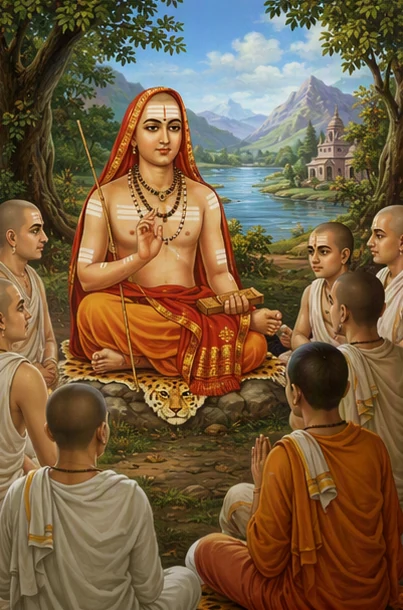
Adi Shankara was born at Kalady on the banks of the Periyar in Kerala, to Shivaguru and Aryamba. Most scholars date his life to around 788–820 CE, while some mathas follow traditions that place him much earlier. Tradition says his father died when he was a child and that he mastered the Vedas while still a boy.
A well-loved story tells how a crocodile seized him while he bathed in the river, and how his mother, to save him, agreed to let him become a sannyasi. He travelled north to the Narmada, where he became the disciple of Govinda Bhagavatpada, and then on to Kashi. In the years that followed he walked across India, debating scholars and teaching, before he is said to have left his body at Kedarnath at the age of thirty-two.
Adi Shankaracharya was born in the village of Kalady in Kerala, on the banks of the Periyar river, to Shivaguru and Aryamba; tradition lovingly remembers him as an ansh-avatar of Lord Shiva. A child of extraordinary intellect, he had absorbed the Vedas and Upanishads while still of playing age. His father passed away in his childhood, and his mother raised and taught him. When the young Shankar wished to take sannyasa, his mother could not bear to agree — until, during a bath in the river, a sudden difficulty arose and the mother's heart melted; she gave her blessing, and Shankar set out, becoming the disciple of Guru Govinda Bhagavatpada on the banks of the Narmada.
In a remarkably short life, he wrote the great commentaries (bhashyas) on the Upanishads, the Bhagavad Gita and the Brahma Sutras, giving Advaita Vedanta its firm foundation, and walked the length and breadth of India sharing knowledge — not confining wisdom to one place. Tradition credits him with establishing four mathas in the four directions — Jyotirmath in the north, Sringeri Sharada Peeth in the south, Govardhan Math (Puri) in the east and Sharada Math (Dwarka) in the west — so that the light of learning would keep travelling in every direction.
Advaita and the four mathas
Shankara taught Advaita Vedanta, non-dualism: that Brahman, pure consciousness, is the only reality, that the individual self (atman) is not different from it, and that the world of separateness is maya. Liberation, in this view, comes from knowledge that removes ignorance, supported by devotion and a disciplined life. He wrote commentaries on the Brahma Sutras, the principal Upanishads and the Bhagavad Gita, and many hymns are attributed to him, among them Bhaja Govindam, the Nirvana Shatakam and the Kanakadhara Stotram.
To keep the teaching alive he is said to have founded four mathas at the four corners of India, each headed by a Shankaracharya:
- Sringeri Sharada Peetham in Karnataka, in the south
- Dwarka Sharada Peetham in Gujarat, in the west
- Govardhan Matha at Puri in Odisha, in the east
- Jyotirmath near Badrinath in Uttarakhand, in the north
He also organised sannyasis into the Dashanami order of ten names, such as Giri, Puri, Saraswati and Bharati, which continues today.
How the jayanti is kept
- At the mathas: Sringeri, Kanchi, Kalady and the other peethams hold several days of Shankara Jayanti celebrations with Vedic chanting, abhishek, processions and discourses.
- At home: people place a picture of Adi Shankara with flowers and a lamp, read or sing Bhaja Govindam or the Nirvana Shatakam, and study a passage from the Gita or an Upanishad.
- Satsang and seva: study groups and Vedanta societies hold talks on his teaching, and many people feed sannyasis or donate books.
Nirvana Shatakam, first verse
मनोबुद्ध्यहङ्कारचित्तानि नाहं
न च श्रोत्रजिह्वे न च घ्राणनेत्रे।
न च व्योमभूमिर्न तेजो न वायुः
चिदानन्दरूपः शिवोऽहं शिवोऽहम्॥
Mano-buddhy-ahankara-chittani naham,
na cha shrotra-jihve na cha ghrana-netre,
na cha vyoma-bhumir na tejo na vayuh,
chid-ananda-rupah shivo'ham shivo'ham.
"I am not the mind, the intellect, the ego or memory; not the ears, the tongue, the nose or the eyes; not space, earth, fire or air. I am consciousness and bliss: I am Shiva, I am Shiva."
Verse in praise of Shankara
श्रुतिस्मृतिपुराणानाम् आलयं करुणालयम्।
नमामि भगवत्पादं शङ्करं लोकशङ्करम्॥
Shruti-smriti-puranana alayam karunalayam,
namami bhagavatpadam Shankaram loka-shankaram.
"I bow to Bhagavatpada Shankara, the home of the Shruti, Smriti and Puranas, the abode of compassion, who brings good to the world."
Dates and timings for 2027
In 2027 the Panchami begins just after sunrise on 10 May and ends before sunrise on the 11th, so it is not the sunrise tithi on either day. It covers the whole daytime of 10 May, which is the date the panchangs give.
Timings are for New Delhi (IST). Checked against BhaktiBharat, Hindu Blog and our own tithi calculation.
Every festival and vrat of the month, with Pradosh, Sangrand, Purnima and Amavasya, is on our May 2027 festivals page.
All 2027 festivals, vrats, Purnima, Amavasya and Sangrand dates are in our 2027 festival calendar.
Questions about Adi Shankaracharya Jayanti
When is Adi Shankaracharya Jayanti in 2027?
On Monday, 10 May 2027. Vaishakha Shukla Panchami runs from 6:22 AM on 10 May to 3:47 AM on 11 May, so it covers the whole day of the 10th.
Where was Adi Shankaracharya born?
At Kalady, on the Periyar river in present-day Ernakulam district of Kerala, according to tradition. A memorial tower and temples mark the spot.
What is Advaita Vedanta?
The teaching that Brahman, pure consciousness, is the one reality and that the individual self is not separate from it. Shankara gave it its classical form in his commentaries.
Which are the four mathas founded by Adi Shankaracharya?
Sringeri in Karnataka, Dwarka in Gujarat, Puri in Odisha and Jyotirmath in Uttarakhand.
Festival customs vary by region and family. Follow the practice of your own family and temple where it differs from what is written here.