- Date in 2027
- Sunday, 9 May
- Tithi
- Vaishakha Shukla Tritiya
- Puja muhurat (New Delhi)
- 5:35 – 9:03 AM, 9 May
- Also called
- Akha Teej, Akti
- Worship of
- Lakshmi-Narayan, Ganesh and Kuber
- Same tithi
- Parashurama Jayanti (evening of 8 May)
What Akshaya Tritiya means
Akshaya means "that which never diminishes". The third day of the bright half of Vaishakha is one of the few days in the Hindu year considered auspicious from sunrise to sunset, a svayam siddha muhurta that needs no separate muhurat to be chosen. Charity, japa, puja and new beginnings on this day are believed to bear fruit that does not run out.
Many stories are attached to the day. It is counted as the beginning of the Treta Yuga. Draupadi is said to have received the akshaya patra, the vessel that never emptied, from Lord Krishna, and Sudama is said to have visited Krishna with his handful of beaten rice. Many families also remember it as the day Ved Vyasa began dictating the Mahabharata to Lord Ganesh.
The stories of Akshaya Tritiya
“Akshaya” means that which never diminishes — and many sacred beginnings are remembered on this one day. The most loved story is of the Akshaya Patra. During their exile, Yudhishthira prayed to Surya Dev, who blessed him with a divine vessel, the Akshaya Patra, which would provide endless food each day until Draupadi herself had eaten. Once, after Draupadi had finished her meal and the vessel was empty, Sage Durvasa arrived with his disciples expecting food. In difficulty, Draupadi prayed to Shri Krishna, who came and ate a single remaining grain of rice from the vessel — and with that one grain, Durvasa and all his disciples, far away, felt completely satisfied and quietly departed.
The day is also remembered as the birth anniversary of Lord Parashurama, the sixth avatar of Vishnu; tradition also connects this tithi with the beginning of the Treta Yuga, with Maa Ganga's descent to earth, and with the day Sage Vyasa began dictating the Mahabharata to Lord Ganesh. The meeting of Krishna and his childhood friend Sudama, who brought a humble bundle of flattened rice, is also lovingly remembered with this day of endless giving.
Akshaya Tritiya puja vidhi
Puja samagri
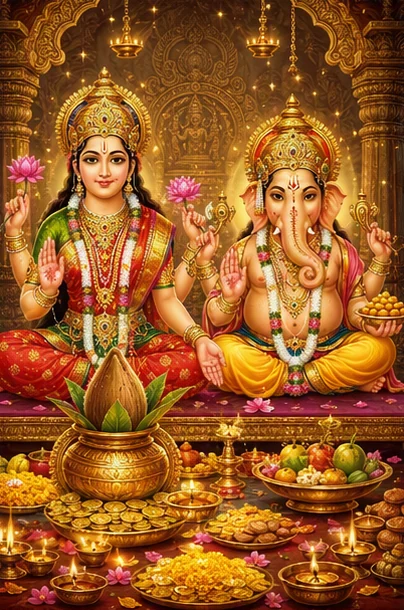
- Pictures or idols of Lakshmi-Narayan and Lord Ganesh
- A kalash of water with mango leaves and a coconut
- Yellow and red flowers, tulsi leaves, sandalwood, haldi, kumkum and akshat
- A ghee lamp, incense and camphor
- Naivedya: kheer, sattu, fruit or soaked gram and jaggery
- Any gold or silver item bought for the day, to be placed before the deity
Puja vidhi
- Rise early, bathe and wear clean clothes, yellow if you can.
- Clean the puja place, set up the kalash and the pictures of Ganesh and Lakshmi-Narayan.
- Begin with Lord Ganesh, then offer sandalwood, flowers, tulsi, akshat and the naivedya to Lakshmi-Narayan.
- Place any new gold, silver or account book before the deity and ask for its blessing.
- Chant the Lakshmi and Vishnu mantras, end with the aarti, and give the day's daan.
Lakshmi mantra
ॐ श्रीं महालक्ष्म्यै नमः॥
Om Shreem Mahalakshmyai Namah.
A simple mantra to Goddess Lakshmi, chanted 108 times on Akshaya Tritiya.
Vishnu mantra
ॐ नमो भगवते वासुदेवाय॥
Om Namo Bhagavate Vasudevaya.
Gold, daan and new beginnings
- Buying gold: gold and silver bought on Akshaya Tritiya are believed to grow, which is why jewellers stay open late. Many families buy only a small coin, and the custom is just as well kept by buying something useful for the home. Because the whole day is a svayam siddha muhurta, there is no separate gold buying muhurat to wait for.
- Summer daan: the classic gifts are a clay pot of water (ghada or matka), a hand fan, an umbrella, footwear, sattu, jaggery, curd-rice and seasonal fruit, all meant to ease the heat of Vaishakha.
- Weddings and housewarmings: because the whole day is auspicious, it is a favourite date for weddings, especially in Rajasthan and Madhya Pradesh, where it is called Akha Teej, and for gruha pravesh.
- New ventures: farmers in many regions begin preparing their fields, and traders open new account books.
Across India and in Jainism
- Puri: construction of the three chariots for the Jagannath Rath Yatra begins, and the Chandan Yatra, the sandalwood festival of the deities, starts.
- Himalayas: the portals of the Gangotri and Yamunotri temples traditionally open for the summer around this day.
- Simhachalam: the sandalwood covering of Lord Varaha-Narasimha is removed for the year's only nija rupa darshan, the Chandanotsavam.
- Karnataka: Basava Jayanti, the birth anniversary of the twelfth-century reformer Basavanna, is usually kept on this day.
- Jains: remember Lord Rishabhdev, the first Tirthankara, breaking his year-long fast with sugarcane juice; those who kept the Varshitap fast break it today.
Dates and timings for 2027
Why 9 May
The Tritiya begins at 11:42 AM on 8 May and is the tithi at sunrise on 9 May, ending at 9:03 AM. Akshaya Tritiya follows the tithi at sunrise, so it is kept on Sunday, 9 May. The evening of 8 May is Parashurama Jayanti.
Timings are for New Delhi (IST). Checked against Drik Panchang (New Delhi), Prokerala, Tirth.com and BhaktiBharat.
Every festival and vrat of the month, with Pradosh, Sangrand, Purnima and Amavasya, is on our May 2027 festivals page.
All 2027 festivals, vrats, Purnima, Amavasya and Sangrand dates are in our 2027 festival calendar.
Questions about Akshaya Tritiya
When is Akshaya Tritiya in 2027?
On Sunday, 9 May 2027. Tritiya runs from 11:42 AM on 8 May to 9:03 AM on 9 May, and it is the tithi at sunrise on 9 May. The puja muhurat in New Delhi is 5:35 AM to 9:03 AM.
Is there a muhurat for buying gold?
Akshaya Tritiya is treated as auspicious for the whole day, so most families simply buy on the day they keep. The puja itself is usually done in the morning.
What should be donated on Akshaya Tritiya?
Things that help in summer: a pot of water, a fan, an umbrella, footwear, sattu, jaggery, fruit and food. Gifts of food and water are considered the most meritorious.
Why are weddings held on Akshaya Tritiya?
The whole day counts as an abujh muhurat, an auspicious time that needs no further checking, so couples can marry without a separate muhurat being fixed.
Festival customs vary by region and family. Follow the practice of your own family and temple where it differs from what is written here.