Your guide to Indian festivals, traditions and celebrations.Explore Indian festivals, vrat days and cultural traditions.Discover festival calendars and important Panchang information.Learn about India's festivals in English and Hindi.
The five days of Diwali, Chhath, Tulsi Vivah, Guru Nanak Jayanti and Dev Deepawali: every major observance of November 2026, with the tithi behind each date.
Finding a date: the table below lists this month's festivals and vrats by date. Tap a name to see its timings and details, or to open its full guide. “Back to the list” after each festival brings you back to the table.
Sangrand this month: Maghar Sangrand falls on Monday, 16 November 2026, the first day of the Punjabi month of Maghar (the sun enters Vrishchika in the evening). All 12 Sangrand dates for 2026
Tithi times are calculated for New Delhi in IST. A tithi begins and ends at the same moment everywhere in India, but sunrise, sunset and moonrise change with your city, and some regional panchangs keep a festival a day apart. Please check locally before a ritual.
Sunday, 1 November 2026Ahoi Ashtami
Kartik Krishna Ashtami · evening vrat
In 2027: Ahoi Ashtami falls on Friday, 22 October. Puja Muhurat (New Delhi) 5:45–7:01 PM · stars visible (Sanjh) at 6:09 PM · moonrise 11:41 PM.
Ahoi Ashtami is a fast mothers keep for the health and long life of their children, mostly in North India. It comes a week before Diwali, on the Ashtami that follows Karwa Chauth. Ashtami tithi begins in the afternoon of 1 November and runs through the evening, which is the time that matters for this vrat.
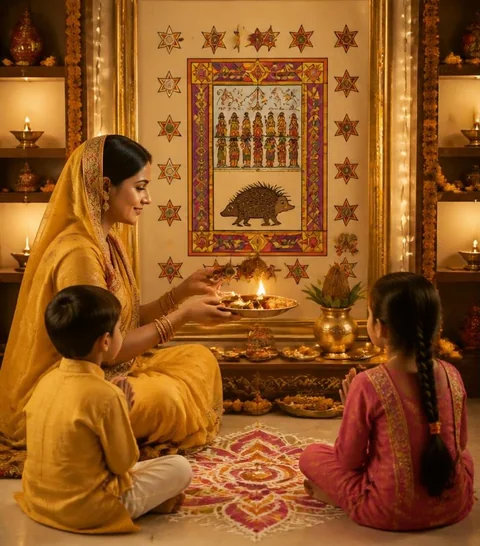
The fast usually lasts from sunrise until the stars appear. In the evening the family draws or hangs a picture of Ahoi Mata, often shown with a porcupine (sei) and her cubs, places a karwa of water before her, and listens to the Ahoi katha. The fast is broken after offering arghya to the stars, and in some families after moonrise, which is late on this night.
Ashtami tithi2:51 PM, 1 Nov – 1:10 PM, 2 Nov
Puja Muhurat (New Delhi)5:36–6:54 PM
Sunset / moonrise, 1 Nov (New Delhi)5:36 PM / 11:40 PM
A picture of Ahoi Mata, or one drawn on the wall with geru (red ochre), showing the goddess with a sei (porcupine) and her young
A karwa of water, often the same one used on Karwa Chauth, for the arghya to the stars
Roli, akshat, flowers, a ghee diya and incense
The food offering: halwa, puri, boiled chana or eight puas, and some sweets
In some families a silver Ahoi locket (syau) threaded with beads, added to each year
The bayana: food and a gift for the mother-in-law
Puja vidhi
Fast from sunrise, without grain and often without water, praying for your children's health.
In the evening, before sunset, draw or set up the picture of Ahoi Mata and place the karwa of water before it.
Worship her with roli, akshat and flowers, offer the halwa-puri and light the diya.
Listen to the Ahoi katha with the children of the family beside you.
Give the bayana to your mother-in-law or an elder woman and take her blessing.
When the stars appear, offer arghya with water from the karwa and break the fast.
The Ahoi katha in brief
A woman went to the forest to dig soil for plastering her house before Diwali and by accident killed a cub of a sei with her spade. Within a year she lost her seven sons. On the advice of an elderly woman she prayed to Ahoi Mata on Kartik Krishna Ashtami, drawing the sei and her cubs beside the goddess and asking forgiveness. Moved by her repentance, Ahoi Mata blessed her and her sons were restored. That is why the sei and her young appear in the Ahoi picture.
Questions about Ahoi Ashtami 2026
When is Ahoi Ashtami in 2026?
Sunday, 1 November 2026. Ashtami tithi begins at 2:51 PM that afternoon and is running in the evening, which is when the puja and the arghya to the stars are done.
When is the Ahoi Ashtami fast broken?
Most families break it after the first stars appear, which in New Delhi is from about 6:00 PM. Some wait for the moon instead; on this night moonrise is late, about 11:40 PM in New Delhi.
Is Ahoi Ashtami kept only for sons?
Traditionally it was kept for sons, but today most mothers keep it for all their children, daughters as well as sons. Some couples who are hoping for a child also keep it.
In 2027: Dhanteras falls on Wednesday, 27 October. Trayodashi tithi 1:03 AM – 10:49 PM, 27 October · Dhanteras puja muhurat (New Delhi) 6:42–8:14 PM.
Dhanteras, or Dhanatrayodashi, opens the five days of Diwali. It honours Lord Dhanvantari, the physician of the gods, who is said to have risen from the churning of the ocean holding a pot of amrit, and who is honoured as the divine teacher of Ayurveda. Trayodashi is running at sunset on 6 November, which is when the evening puja is done.
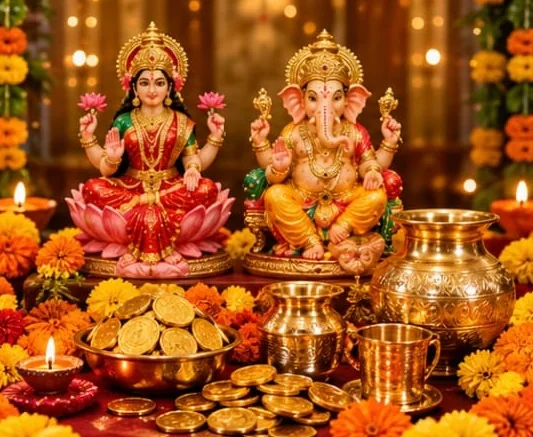
Families buy something new for the home, traditionally gold, silver or a steel or brass utensil, as a sign of prosperity for the year ahead. In the evening they worship Goddess Lakshmi, Lord Kuber and Dhanvantari, and light a lamp facing south at the doorway, the Yama Deepam, in the hope of keeping untimely death away from the family.
When the devas and the asuras churned the ocean of milk, with Mount Mandara as the churning rod and the serpent Vasuki as the rope, treasure after treasure rose from the waters. Last of all, on Kartik Krishna Trayodashi, Lord Dhanvantari appeared, holding a golden kalash full of amrit, the nectar of immortality, and bringing with him the knowledge of healing.
Dhanvantari is regarded as a form of Lord Vishnu and as the physician of the gods, the first teacher of Ayurveda. Because he came holding a pot, buying a new metal vessel on Dhanteras became a way of welcoming health and prosperity into the home. Families pray to him for good health, which tradition calls the first wealth of all.
The Yama Deepdaan katha in brief
The lighting of the Yama Deepam on Dhanteras carries a beloved folk tale. It is said that the sixteen-year-old son of King Hima was foretold to die on the fourth day of his marriage, bitten by a serpent. When that night came, his young bride did not sleep and did not let her husband sleep either: she heaped her gold and silver ornaments at the door, lit lamps all around, and kept the whole night alive with stories and songs. Yamraj arrived in the form of a serpent — but the blaze of the lamps and the glittering heap dazzled his eyes, and instead of entering, he sat upon the heap of gold and listened, spellbound, to the bride's songs and tales until the dawn.
Then he quietly turned back, empty-handed — and the prince's life was saved by a lamp, a heap of devotion and a wife's sleepless love. That is why, on Dhanteras evening, families light a lamp facing south for Yamraj — the Yama Deepdaan — praying for the long life and safety of the family.
Trayodashi tithi10:30 AM, 6 Nov – 10:47 AM, 7 Nov
Sunset, 6 Nov (New Delhi)5:33 PM
Dhanteras puja muhurat (New Delhi)6:02 PM – 7:57 PM
Pradosh Kaal5:33 PM – 8:09 PM
Vrishabha Kaal6:02 PM – 7:57 PM
About Ayurveda Day: National Ayurveda Day used to be observed on Dhanteras. From 2025 the Ministry of Ayush has fixed it on 23 September every year, so it no longer moves with the festival.
Puja samagri
Pictures or idols of Lord Ganesh, Goddess Lakshmi, Lord Kuber and Lord Dhanvantari
The new utensil, coin or jewellery bought that day, to be placed in the puja
Roli, haldi, akshat, flowers, a ghee diya and incense
Whole coriander seeds (sabut dhaniya), jaggery and sweets for the offering
Thirteen small diyas for the house, and one four-wick clay diya with mustard oil for the Yama Deepam
Puja vidhi
Clean the house, draw a rangoli at the entrance and decorate the puja corner during the day.
Bring home the new item before the evening puja, avoiding Rahu Kaal if your family keeps it (10:43 AM to 12:05 PM in New Delhi on this Friday).
In the evening muhurat, worship Ganesh first, then Lakshmi and Kuber, offering roli, akshat, flowers, coriander seeds and sweets, and place the new item before them.
Worship Dhanvantari with a prayer for good health for the whole family.
Light the thirteen diyas around the house.
Light the four-wick Yama Deepam and place it outside the main door facing south, saying the Yama Deepdaan mantra.
Mantras
Ganesh vandana
वक्रतुण्ड महाकाय सूर्यकोटि समप्रभ। निर्विघ्नं कुरु मे देव सर्वकार्येषु सर्वदा॥
Vakratunda mahakaya suryakoti samaprabha, nirvighnam kuru me deva sarvakaryeshu sarvada.
Most pujas begin with Lord Ganesh, asking that the work go ahead without obstacles.
Said while placing the Yama Deepam: "May Yama, son of Surya, be pleased with this lamp offered on Trayodashi."
Questions about Dhanteras 2026
What is the Dhanteras puja time in 2026?
In New Delhi the Dhanteras puja muhurat on Friday, 6 November is 6:02 PM to 7:57 PM. This is the part of Pradosh Kaal (5:33 PM to 8:09 PM) when the fixed sign Vrishabha is rising, and Trayodashi is running throughout. Other cities differ by a few minutes.
What should I buy on Dhanteras?
Traditionally something of metal for the home: a steel, brass or copper utensil, a silver coin, or gold if the family wishes. Many also buy a new broom, which stands for sweeping away poverty, and whole coriander seeds, which are offered in the puja and later sown or kept with savings. Buying something expensive is not required; the gesture is what counts.
When is the Yama Deepam lit?
In the evening of Dhanteras, during Pradosh Kaal, which is 5:33 PM to 8:09 PM in New Delhi on 6 November. A four-wick clay lamp with mustard oil is placed outside the main door, facing south.
Saturday, 7 November 2026Kali Chaudas · Narak Chaturdashi
Kartik Krishna Chaturdashi · Choti Diwali
In 2027: Narak Chaturdashi (Choti Diwali) falls on Thursday, 28 October, and Kali Chaudas on the night of Wednesday, 27 October (Nishita 11:39 PM – 12:30 AM, New Delhi). Chaturdashi tithi 10:49 PM, 27 October – 8:47 PM, 28 October · Abhyang snan muhurat (New Delhi) 5:06–6:30 AM, 28 October.
The Chaturdashi before Diwali remembers Lord Krishna's victory over the demon Narakasura, who had imprisoned thousands of women. In 2026 Chaturdashi begins in the late morning of 7 November and ends late the next morning, so the observances are split across two days:
7 November, evening and night: Kali Chaudas in Gujarat and Maharashtra, when Maa Kali and Hanuman are worshipped to remove fear and negativity, and Choti Diwali, when the first row of lamps is lit at home.
8 November, before sunrise: the abhyang snan of Narak Chaturdashi, an oil bath before dawn, falls on this morning because Chaturdashi is the tithi at sunrise. In South India this morning is celebrated as Deepavali itself.
The day ends with Diwali Lakshmi Puja that same evening.
Narak Chaturdashi, celebrated a day before Diwali, remembers the end of the demon Narakasura. Narakasura, the son of Maa Bhudevi (Mother Earth), was the king of Pragjyotishpur (in present-day Assam). Blessed with power, he grew arrogant: he troubled gods, sages and humans alike, seized the divine earrings of Dev-mata Aditi, and imprisoned more than sixteen thousand maidens in his palace. Troubled Indra went to Dwarka and begged Shri Krishna's help. Narakasura had a boon — he could be defeated only by his own mother. So Krishna went to battle with Satyabhama beside him on Garuda — Satyabhama, who is revered as an ansh (portion) of Maa Bhudevi herself.
The fortress's guardian Mura was defeated first; then, in the great battle, it was Satyabhama who, stepping forward like a mother, struck the final blow — and the boon was fulfilled through a mother's own hand. After Narakasura's fall, Krishna freed all the imprisoned maidens and, to protect their honour, gave them a respected place; Bhudevi herself asked that her son's end be remembered not with darkness but with light. That is why devotees rise before dawn on this day for the Abhyang Snan (sacred oil bath) and light lamps — celebrating the victory of light and freedom over arrogance and captivity.
Chaturdashi tithi10:47 AM, 7 Nov – 11:27 AM, 8 Nov
Abhyang snan, 8 Nov (New Delhi)5:41 AM – 6:38 AM
Kali Chaudas Nishita Kaal, 7 Nov11:39 PM – 12:31 AM
How the two days are kept
Abhyang snan (8 November, before sunrise): rub til oil and an ubtan of gram flour, haldi and herbs on the body, then bathe. In many homes a stalk of apamarga (chirchita) is waved around the head during the bath.
Yama tarpan: after the bath some families offer water with black sesame to Yama, facing south.
Choti Diwali lamps (7 November, evening): a row of diyas at the doorway, the kitchen water point and the courtyard. A lamp of mustard oil is often kept at the rubbish pile or outer corner of the house to keep out misfortune.
Kali Chaudas (7 November, night): worship of Maa Kali and Hanuman around midnight, especially in Gujarat, with sindoor, oil, coconut and black urad.
Mantra
Kali mantra
ॐ क्रीं कालिकायै नमः॥
Om Kreem Kalikayai Namah.
Chanted on the night of Kali Chaudas for protection and courage.
Questions about Kali Chaudas and Narak Chaturdashi 2026
When is Choti Diwali in 2026?
The lamps of Choti Diwali are lit on the evening of Saturday, 7 November, when Chaturdashi has begun. The Narak Chaturdashi abhyang snan falls on the morning of Sunday, 8 November, the same day as Diwali, because Chaturdashi is the tithi at sunrise that day.
What is the abhyang snan time in 2026?
In New Delhi it is from moonrise at about 5:41 AM to sunrise at 6:38 AM on 8 November. Families rub sesame oil and ubtan on the body and bathe before sunrise.
Why is Hanuman worshipped on Kali Chaudas?
In Gujarat and parts of Maharashtra and Karnataka, Kali Chaudas is a night for protection from fear and negative forces, so Maa Kali and Hanuman are both worshipped. Many families offer oil, sindoor and a coconut to Hanuman and keep a lamp burning through the night.
In 2027: Diwali (Lakshmi Puja) falls on Friday, 29 October. Amavasya tithi 8:47 PM, 28 October – 7:05 PM, 29 October · Lakshmi Puja muhurat (New Delhi) 6:34–7:05 PM. The window is short because Amavasya ends at 7:05 PM. Kali Puja is on the night of Thursday, 28 October, when the Amavasya covers midnight: Nishita Kaal 11:39 PM – 12:30 AM in New Delhi and 10:55–11:45 PM in Kolkata. 2027 calendar
Diwali, the festival of lights, is kept on Kartik Amavasya, the darkest night of the month, and it is the high point of a five-day festival. In 2026 the Amavasya tithi begins at 11:27 AM on 8 November and is running at sunset that evening, so Lakshmi Puja and Diwali fall on Sunday, 8 November 2026, about ten days after Karwa Chauth.
The day remembers Lord Rama's return to Ayodhya after fourteen years, when the city lit rows of lamps to welcome him, and it is the night Goddess Lakshmi is believed to visit clean, well-lit homes. Houses are cleaned and lit with rows of diyas and strings of lights, doorways get toran and marigold garlands, and rangoli is drawn at the entrance. In the evening families worship Goddess Lakshmi and Lord Ganesh together, offer sweets, kheel-batashe and fruit, and then share the sweets with neighbours and friends.
Muhurat times are calculated for New Delhi in IST. Pradosh Kaal and Vrishabha Kaal shift with your city, usually by a few minutes, and some panchangs follow slightly different rules. Please check a local panchang if the exact minute matters to your family.
In 2026 the Amavasya ends at midday on 9 November, so Govardhan Puja and Bhai Dooj come a day later than the usual "day after Diwali" pattern, on 10 and 11 November.
Lakshmi Puja samagri
A chowki (low wooden stool) covered with a red or yellow cloth
Idols or a picture of Goddess Lakshmi and Lord Ganesh; many families also keep Saraswati and Kuber
A kalash of water with mango leaves and a coconut, and a small heap of rice or wheat under it
Roli, kumkum, haldi, akshat, chandan, flowers and lotus if available, and a garland of marigolds
Silver coins, the family's account books (bahi-khata) or a new notebook, a pen, and some cash or jewellery to be worshipped
Kheel-batashe, sweets, fruit, betel leaves, supari, cloves, cardamom and dry fruit
One large ghee diya to burn through the night, and plenty of small diyas with oil and wicks
Incense, camphor for the aarti, and a bell
Lakshmi Puja vidhi
Finish cleaning the house during the day, draw rangoli at the entrance and put up the toran. Many families also make small footprints of Lakshmi walking into the house.
Before the muhurat, bathe, wear clean or new clothes, and set up the chowki in the north-east of the room or in the usual puja place.
Place the kalash on a heap of rice, then the idols of Ganesh and Lakshmi, the coins, account books and other items to be worshipped.
Sprinkle water on yourself and the puja items, light the large diya, and take the sankalpa with water, akshat and a flower in your hand.
Worship Ganesh first, then the kalash, and then Lakshmi: offer water, roli, akshat, flowers, the garland, kheel-batashe, sweets and fruit.
Worship the account books, pen and coins with roli and akshat. Traders often write "shubh" and "labh" and draw a swastika in the new books.
Chant the Lakshmi mantra 108 times or as many times as you can, and sing the Ganesh aarti and then the Lakshmi aarti.
Light the small diyas and place them around the house, at the doorway, windows, the kitchen and the tulsi, then share the prasad.
Mantras
Ganesh vandana
वक्रतुण्ड महाकाय सूर्यकोटि समप्रभ। निर्विघ्नं कुरु मे देव सर्वकार्येषु सर्वदा॥
Vakratunda mahakaya suryakoti samaprabha, nirvighnam kuru me deva sarvakaryeshu sarvada.
Most pujas begin with Lord Ganesh, asking that the work go ahead without obstacles.
Om shreem hreem shreem kamale kamalalaye praseed praseed shreem hreem shreem Om Mahalakshmyai namah.
Lakshmi Gayatri
ॐ महालक्ष्म्यै च विद्महे विष्णुपत्न्यै च धीमहि। तन्नो लक्ष्मीः प्रचोदयात्॥
Om Mahalakshmyai cha vidmahe Vishnupatnyai cha dheemahi, tanno Lakshmih prachodayat.
A simpler choice for anyone new to the puja is "Om Shri Mahalakshmyai Namah".
Aarti
Aarti: Om Jai Lakshmi Mata
The aarti of Goddess Lakshmi sung at the end of the Diwali puja, usually after the Ganesh aarti. Wording differs slightly between families and printed aarti books.
ॐ जय लक्ष्मी माता, मैया जय लक्ष्मी माता। तुमको निशदिन सेवत, हरि विष्णु विधाता॥ ॐ जय लक्ष्मी माता॥
Om Jai Lakshmi Mata, Maiya Jai Lakshmi Mata, Tumko nishdin sevat, Hari Vishnu Vidhata. Om Jai Lakshmi Mata.
महालक्ष्मी जी की आरती, जो कोई नर गाता। उर आनन्द समाता, पाप उतर जाता॥
Mahalakshmi ji ki aarti, jo koi nar gata, Ur anand samata, paap utar jata.
Diwali across India
North India: Lakshmi-Ganesh puja in the evening, lamps and rangoli, and visits to family with sweets and dry fruit.
Bengal, Odisha and Assam: Kali Puja at midnight on the same Amavasya, with lamps lit for the ancestors.
Gujarat: Diwali closes the year in the Vikram Samvat calendar, and new account books are opened; the New Year, Bestu Varas, follows on 10 November.
Tamil Nadu, Karnataka and the South: Deepavali is celebrated at dawn with an oil bath, new clothes and sweets, on Naraka Chaturdashi.
Sikh tradition: Bandi Chhor Divas, remembering Guru Hargobind Sahib Ji's release from Gwalior fort, is marked the same evening, with the Harmandir Sahib lit up.
Jain tradition: Diwali marks the nirvana of Bhagwan Mahavir, and many Jains observe it with fasting and prayer.
Questions about Diwali 2026
When is Diwali in 2026?
Sunday, 8 November 2026. Amavasya tithi begins at 11:27 AM that day and is running at sunset and through Pradosh Kaal, the evening window in which Lakshmi Puja is done, so 8 November is the date in almost all North Indian panchangs.
What is the Lakshmi Puja muhurat on Diwali 2026?
In New Delhi it is 5:54 PM to 7:50 PM on 8 November: the part of Pradosh Kaal (5:31 PM to 8:09 PM) when the fixed sign Vrishabha is rising. If you cannot do the puja then, any time in Pradosh Kaal is considered good. Muhurat times shift by a few minutes in other cities, and some panchangs use slightly different rules.
Why is Diwali on 8 November and not 9 November?
Lakshmi Puja is done on the evening when Amavasya covers Pradosh Kaal. On 8 November Amavasya runs through the whole evening. On 9 November it ends at 12:31 PM, before sunset, so the evening of the 9th is already Pratipada.
When is Kali Puja in 2026?
In Bengal, Odisha and Assam, Kali Puja is done at midnight on Amavasya, which in 2026 is also the night of Sunday, 8 November. The Nishita Kaal in New Delhi is 11:39 PM to 12:31 AM.
Which way should the idols face for Lakshmi Puja?
Many families place Lakshmi and Ganesh on a raised chowki so that they face east or west and the person doing the puja faces them, with Ganesh on Lakshmi's left (to her right as you look at them). Family tradition takes priority over any general rule.
Is the Diwali date the same in South India?
In Tamil Nadu, Karnataka and much of the South, Deepavali is celebrated on the morning of Naraka Chaturdashi with an oil bath before dawn, which in 2026 is also the morning of Sunday, 8 November. So the date is the same, though the main celebration is in the morning rather than the evening.
In 2027: Vishwakarma Day falls on Saturday, 30 October, the day after Diwali (Friday, 29 October).
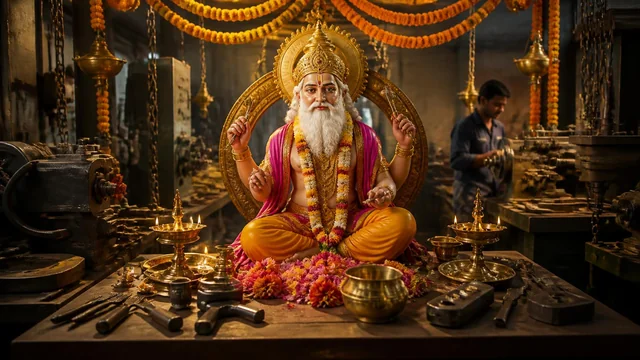
Lord Vishwakarma is the divine architect and craftsman of Hindu tradition, said to have built Dwarka, Indraprastha and the weapons and chariots of the gods. In Punjab, Haryana, Delhi, Himachal Pradesh and parts of Uttar Pradesh his day is kept on the day after Diwali, which in 2026 is Monday, 9 November, and it is a holiday in several of these states.
Factories, workshops, garages and offices pause their regular work. Machines, tools and vehicles are cleaned and decorated with marigolds, a picture or idol of Vishwakarma is set up, and workers and owners perform the puja together before sharing prasad. For families who run a trade, and for carpenters, ironsmiths, masons and other artisans, it is one of the most important days of the working year. Where the day after Diwali is also kept as Govardhan Puja the two are often celebrated together; by our New Delhi Panchang, the Pratipada morning and Govardhan Puja fall on 10 November.
Not the same as Vishwakarma Puja in September: in Bengal, Odisha, Assam, Jharkhand, Bihar and Tripura, Vishwakarma Puja follows the solar calendar and is kept on Kanya Sankranti, around 17 September. The 9 November observance is the North Indian one linked to Diwali.
Lord Vishwakarma is honoured as the divine architect of the gods — the craftsman before whom every tool is a prayer. Tradition credits his hands with wonders across the ages: the golden city of Lanka on the seashore (which first came to Kubera, along with the Pushpak Vimana); and Dwarka, the beautiful planned city raised for Shri Krishna by the sea — wide roads, gardens, palaces and four great gates, built, it is said, in a single day. From the sun's trimmed radiance, tradition adds, he fashioned Vishnu's Sudarshan Chakra and Shiva's Trishul.
Because his day is kept around Diwali in many homes and workshops, tools, machines and instruments are cleaned, decorated and worshipped — a thanksgiving to the divine maker, and a promise to do one's own work with skill and honesty.
Rahu Kaal, 9 Nov (New Delhi)8:00 AM – 9:21 AM
Puja samagri
A picture or idol of Lord Vishwakarma, often shown with a white beard, four arms and craftsman's tools
The tools, machines, vehicles and account books to be worshipped, cleaned the day before
Roli, haldi, akshat, flowers, marigold garlands, a diya and incense
Sweets, fruit and panjiri or boondi for prasad, and a coconut
Puja vidhi
Clean the workshop, office or shop and every machine and tool the day before.
In the morning, set up the picture of Vishwakarma and arrange the tools and machines in front of it or decorate them in place.
Worship Ganesh, then Vishwakarma, offering roli, akshat, flowers and sweets, and apply a roli tilak and tie kalawa on the tools and machines.
Do the aarti together, break the coconut, and share prasad with everyone who works there. Machines usually rest for the day.
Mantra
Vishwakarma mantra
ॐ विश्वकर्मणे नमः॥
Om Vishwakarmane namah.
A short mantra chanted while offering flowers to the tools and machines.
Questions about Vishwakarma Day 2026
Is Vishwakarma Day on 9 November in 2026?
In Punjab, Haryana, Delhi, Himachal Pradesh and parts of Uttar Pradesh, yes: it is kept on the day after Diwali, which is Monday, 9 November 2026. In eastern India Vishwakarma Puja is a different observance, kept in September on Kanya Sankranti.
What time should the Vishwakarma puja be done?
Most workshops do it in the morning once the place has been cleaned. If your family avoids Rahu Kaal, on this Monday in New Delhi it is 8:00 AM to 9:21 AM, so a puja after 9:21 AM avoids it.
In 2027: Govardhan Puja and Annakut fall on Saturday, 30 October. Pratipada tithi 7:05 PM, 29 October – 5:51 PM, 30 October · morning muhurat (New Delhi) 6:31–8:45 AM · evening muhurat 3:25–5:38 PM.
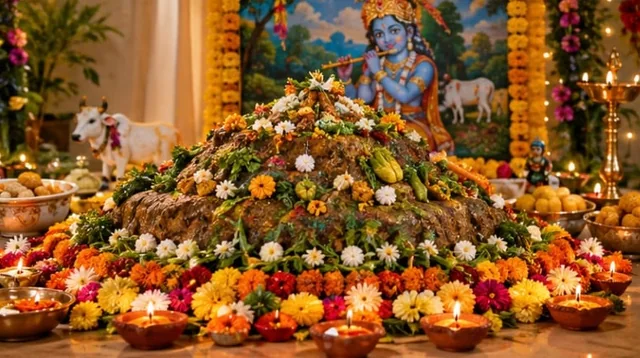
Govardhan Puja remembers Lord Krishna lifting Govardhan hill on his little finger to shelter the people of Braj from Indra's storms. Families shape a small Govardhan from cow dung or clay, decorate it with flowers, walk around it and worship cows. Temples prepare Annakut, "a mountain of food" of dozens of dishes, offered to Krishna and then shared.
Note on the date: some lists show 9 November. On 9 November, though, Amavasya runs until about 12:31 PM and Pratipada begins only after that, so the morning of Pratipada, when Govardhan Puja is done, is Tuesday, 10 November by our New Delhi calculation. In Gujarat the same day is Bestu Varas, the New Year, and in Maharashtra it is Bali Pratipada.
Every year the people of Braj prepared a great offering for Indra, the king of the gods and the giver of rain. The child Krishna asked his father Nanda why they worshipped Indra, when it was the Govardhan hill that gave their cows grass and their village water and shelter. Persuaded by him, the people of Braj made their offering to Govardhan instead, and walked around the hill in worship.
Indra was angered and sent storms and rain that would not stop. As the water rose and the people and cattle of Braj cried out for help, Krishna lifted the whole Govardhan hill on the little finger of his left hand and held it up like an umbrella. For seven days the whole village sheltered beneath it, until Indra understood his mistake, stopped the rain and came to ask Krishna's forgiveness. From then on Krishna was called Govardhandhari and Giridhari. Annakut, the “mountain of food” offered on this day, remembers the offering the people of Braj made to the hill.
Pratipada tithi12:31 PM, 9 Nov – 2:00 PM, 10 Nov
Pratahkala muhurat, 10 Nov (New Delhi)6:40 AM – 8:50 AM
Puja samagri
Cow dung or clay to shape a small Govardhan hill, with a figure of Krishna lying at its centre
Flowers, cotton wool for the trees and grass on the hill, and small sticks or sugarcane
Roli, akshat, a diya, incense, milk, curd, jaggery and batashe
The Annakut: as many dishes as the family can make, or a simple offering of kadhi, rice and a seasonal vegetable
Puja vidhi
In the morning, shape the Govardhan in the courtyard or at the doorway and decorate it with flowers.
Worship it with roli, akshat, milk, curd and a diya, and offer the Annakut or the simple meal.
Walk around the Govardhan seven times with the family, pouring a thin stream of milk or water and scattering grain as you go.
Worship the cows and calves of the household or neighbourhood with tilak and feed them.
"O Govardhan, support of the earth and protector of Gokul, raised high by Vishnu's arm, bless us with prosperity."
Questions about Govardhan Puja 2026
Is Govardhan Puja on 9 or 10 November 2026?
By our New Delhi Panchang it is Tuesday, 10 November. Amavasya lasts until 12:31 PM on 9 November, so the morning of Pratipada, the time for Govardhan Puja, is the morning of the 10th. Some calendars that follow a different rule list 9 November.
What is Annakut?
Annakut means "a mountain of food". Temples and many homes cook dozens of dishes, from kadhi-chawal and mixed vegetables to sweets, and arrange them in a heap before Krishna as thanks for the harvest. The food is then shared as prasad.
In 2027: Bhai Dooj falls on Sunday, 31 October. Dwitiya tithi 5:51 PM, 30 October – 5:12 PM, 31 October · tilak (Aparahna) muhurat (New Delhi) 1:11–3:24 PM.
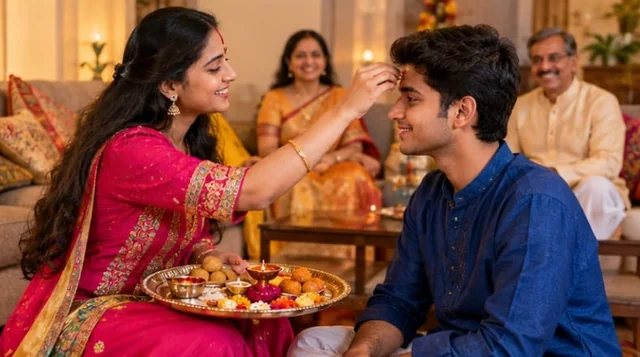
Bhai Dooj closes the Diwali festival with a celebration of brothers and sisters. The story goes that Yamraj visited his sister Yamuna on this day, and she welcomed him with tilak, aarti and a meal, so it is also called Yama Dwitiya. Sisters apply a tilak of roli and rice to their brothers' foreheads, do aarti, feed them sweets and pray for their long life; brothers give a gift in return.
Dwitiya covers the afternoon of Wednesday, 11 November, the time traditionally preferred for the tilak. The day is Bhau Beej in Maharashtra, Bhai Phonta in Bengal (where it is often kept on the date of the local calendar) and Bhai Tika in Nepal.
Bhai Dooj carries the tender story of Yamraj and his sister Yamuna. Yamuna would invite her brother home for a meal again and again, but Yamraj, busy in his duties, kept postponing — and the two did not meet for a very long time. At last, on Kartik Shukla Dwitiya, Yamraj came to his sister's home — and it is said that before coming, he freed all beings from the fear of Yama-paash, and celebration spread through Yamalok itself. Yamuna's joy knew no bounds: she bathed her brother, dressed him in fine clothes and ornaments, applied chandan, garlanded him, performed his aarti, put a tilak on his forehead, and served him many delicious dishes on a golden plate.
Pleased, Yamraj gifted his sister clothes and ornaments in return and asked her to choose a boon. Yamuna asked for no wealth: “Come to my home on this day every year — and let every brother who, on this day, receives tilak and eats at his sister's hand be blessed with happiness, prosperity and freedom from the fear of untimely death.” Yamraj granted the boon, and the day became Yama Dwitiya — Bhai Dooj.
Dwitiya tithi2:00 PM, 10 Nov – 3:53 PM, 11 Nov
Aparahna (tilak time), 11 Nov (New Delhi)1:10 PM – 3:20 PM
Puja samagri
A thali with roli, akshat, a diya, sweets, a coconut or a dry coconut (gola), and a few flowers
Kalawa to tie on the brother's wrist, in some families
A chowki or a small rangoli for the brother to sit on
The meal the sister cooks or serves, and a gift from the brother in return
How the tilak is done
The brother visits his sister's home, bathes and sits facing north or east on the chowki.
The sister applies a tilak of roli and akshat, ties kalawa if it is the family custom, and does aarti with the diya.
She offers sweets and the coconut and prays for his long life; he touches her feet if she is older, or blesses her if she is younger, and gives her a gift.
The two share a meal together, as Yamuna fed Yama.
A line many sisters say while applying the tilak: "गंगा पूजे यमुना को, यमी पूजे यमराज को; सुभद्रा पूजे कृष्ण को, गंगा-यमुना नीर बहे, मेरे भाई आप बढ़ें, फूलें-फलें।" It is a folk saying, and every family has its own version.
Questions about Bhai Dooj 2026
What is the Bhai Dooj tilak time in 2026?
Tradition prefers the Aparahna, the afternoon part of the day. On Wednesday, 11 November in New Delhi it is 1:10 PM to 3:20 PM, and Dwitiya lasts until 3:53 PM, so the tilak can be done any time until then.
Why is Bhai Dooj on 11 November and not 10 November?
Dwitiya begins only at 2:00 PM on 10 November and covers the whole of the next morning and afternoon. Because the afternoon of 11 November falls fully in Dwitiya, it is the date given in most North Indian panchangs.
In 2027: Chhath Puja falls on Thursday, 4 November, the day of the Sandhya Arghya (Kartik Shukla Shashthi). Shashthi tithi 7:31 PM, 3 November – 9:37 PM, 4 November (New Delhi).
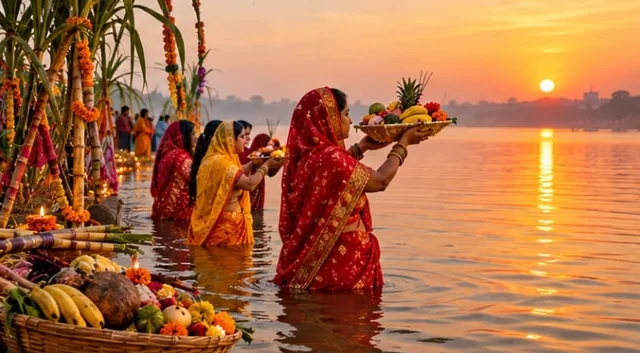
Chhath is the four-day worship of Surya and Chhathi Maiya, kept with great discipline in Bihar, Jharkhand, eastern Uttar Pradesh and the Terai of Nepal, and wherever families from these regions live. Devotees, called vratis, keep a long nirjala fast and offer arghya to the setting and the rising sun while standing in a river or pond.
Fri 13 Nov · Nahay Khay: a holy bath and a single sattvik meal of rice, chana dal and lauki.
Sat 14 Nov · Kharna: a day-long fast ended in the evening with gur kheer and roti; the 36-hour nirjala fast begins after it.
Sun 15 Nov · Sandhya Arghya: arghya to the setting sun at the ghat, with soop baskets of thekua, fruit and sugarcane.
Mon 16 Nov · Usha Arghya: arghya to the rising sun, after which the vrat is completed.
Chhath is dedicated to Surya Dev and Chhathi Maiya — remembered in tradition as the sixth portion (shashthi ansh) of Prakriti, the divine Devi Shashthi (Devasena), the mind-born daughter of Brahma ji and the protectress of children. The principal katha, as told in the Puranas, is of King Priyavrat and Queen Malini, who had no child. On the advice of Rishi Kashyap they performed the Putrakameshti yagya, and a son was born to them — but the child was born lifeless, and the palace drowned in grief. Then, in a divine chariot, Chhathi Maiya appeared; with her divine touch the infant came to life. From that day, tradition says, the worship of Shashthi began.
Other cherished associations are kept as “parampara me kaha jata hai”: that Surya's son Karna would stand in the river every morning offering arghya to the Sun; that Draupadi kept Surya-upasana during the exile; and that in some traditions Ram and Sita, on returning from exile, worshipped Shashthi and the Sun. The four-day discipline of Chhath — Nahay-Khay, Kharna, the evening arghya to the setting sun, and the morning arghya to the rising sun — is kept with gratitude to the Sun who gives life to all.
Shashthi tithi11:23 PM, 14 Nov – 2:00 AM, 16 Nov
Sunset 15 Nov / sunrise 16 Nov (New Delhi)5:28 PM / 6:44 AM
Sunset 15 Nov / sunrise 16 Nov (Patna)5:01 PM / 6:07 AM
Puja samagri
Bamboo soop (winnowing trays) and a daura or dauri (bamboo basket) for each vrati
Thekua, rice laddoos (kasar) and the seasonal fruit of the region: banana, sugarcane, coconut, citrus, singhara, sweet lime, radish and ginger plants
A new set of clothes for the vrati, sindoor, a ghee diya and incense
A brass or copper lota, or a glass of milk, for the arghya
Sugarcane stalks to make a canopy at home or at the ghat
How the four days are kept
Nahay Khay (13 November): the vrati bathes in a river or at home, cleans the house, and eats one sattvik meal of rice, chana dal and lauki cooked without onion or garlic.
Kharna (14 November): a fast through the day, broken after sunset with rasiya (gur kheer) and roti offered first to Chhathi Maiya and then shared. The 36-hour nirjala fast begins after this meal.
Sandhya Arghya (15 November): the family carries the daura to the ghat in the afternoon. Standing in the water, the vrati offers arghya of milk or water to the setting sun with the soop of prasad.
Usha Arghya (16 November): the family returns to the ghat before dawn, sings Chhath geet, and offers arghya to the rising sun. The vrati breaks the fast with prasad and a little ginger and water.
Om ehi Surya sahasramsho tejorashe jagatpate, anukampaya mam bhaktya grihanarghyam divakara.
"O Surya of a thousand rays, store of light and lord of the world, accept this arghya offered with devotion."
Questions about Chhath Puja 2026
What are the Chhath Puja dates in 2026?
Nahay Khay on Friday 13 November, Kharna on Saturday 14 November, Sandhya Arghya on Sunday 15 November and Usha Arghya on Monday 16 November.
What time is the Chhath arghya in 2026?
The arghya is offered at sunset on 15 November and at sunrise on 16 November. In New Delhi sunset is 5:28 PM and sunrise 6:44 AM; in Patna sunset is 5:01 PM and sunrise 6:07 AM. Vratis usually reach the ghat well before, and the arghya is offered as the sun touches the horizon.
What is thekua?
Thekua is the main prasad of Chhath: a crisp sweet of wheat flour, jaggery and ghee, sometimes with coconut and fennel, pressed into a wooden mould and fried. It is made at home with great care, often by the vrati herself.
Chhath Puja 2027 dates, arghya times and the samagri list are in our Chhath Puja guide.
In 2027: Dev Uthani (Prabodhini) Ekadashi falls on Wednesday, 10 November.
Prabodhini (Dev Uthani) Ekadashi is the day Lord Vishnu is said to wake from his four-month sleep. Tulsi Vivah follows it, and with it the wedding season begins. In 2026 Ekadashi tithi runs from 7:15 AM on Friday, 20 November to 6:31 AM on Saturday, 21 November. The Dev Uthani Ekadashi fast is on Friday, 20 November.
The vrat-katha of Prabodhini (Dev Uthani) Ekadashi tells of the asura Shankhyayan, who stole the Vedas so that people would be cut off from knowledge and adharma would spread. The gods and sages carried the news to Lord Vishnu, who struggled long to defeat Shankhyayan and recover the Vedas. Weary from that great effort, Vishnu then rested in yoga-nidra — the divine sleep of Chaturmas, the four monsoon months when auspicious ceremonies pause.
On Kartik Shukla Ekadashi, the gods gathered to awaken him with conches, bells, lamps and hymns — “Uttishtha Govinda!” — “Arise, Govinda!” With his awakening, auspicious works — marriages and celebrations — begin again across the world, and the very next day the divine wedding of Tulsi and Shaligram is celebrated. That is why this Ekadashi is called Dev Uthani — the rising of the Lord.
Ekadashi tithi7:15 AM, 20 Nov – 6:31 AM, 21 Nov
The mantra to wake Lord Vishnu, the Tulsi Vivah puja and its dates are in the Tulsi Vivah section below.
Kartik Shukla Dwadashi · after Dev Uthani Ekadashi
In 2027: Tulsi Vivah falls on Thursday, 11 November (Kartik Shukla Dwadashi).
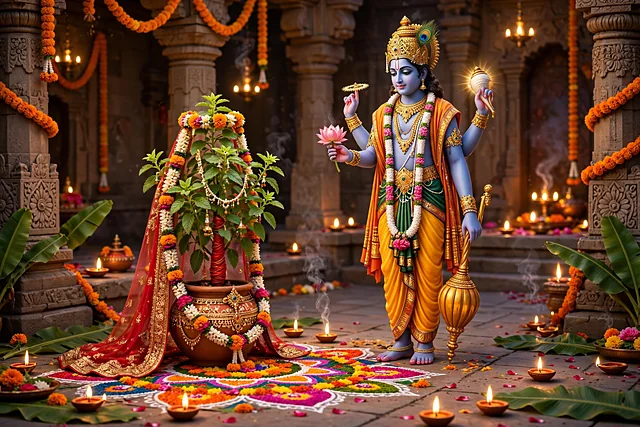
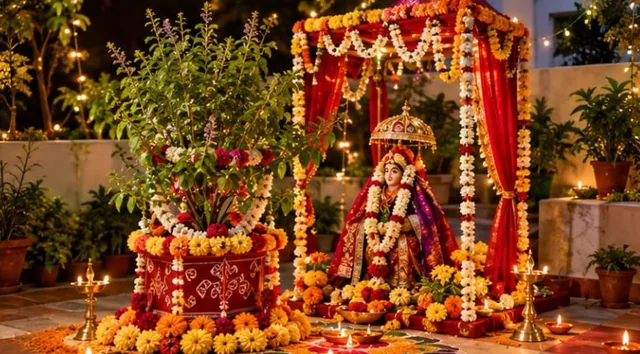
Tulsi Vivah is the ceremonial marriage of the tulsi plant, worshipped as Goddess Vrinda, to Lord Vishnu in his Shaligram form or to Krishna. It follows Prabodhini (Dev Uthani) Ekadashi, when Lord Vishnu is said to wake from his four-month sleep, and it marks the start of the wedding season.
In 2026 Ekadashi runs from 7:15 AM on 20 November to early morning on 21 November, and Dwadashi is the tithi at sunrise on Saturday, 21 November, the day used for Tulsi Vivah here. The tulsi pot is decorated like a bride with a red chunri and bangles, a sugarcane mandap is built over it, and the wedding is completed with mantras, pheras and prasad.
Tulsi Vivah celebrates the divine wedding of Maa Tulsi with Lord Vishnu in his Shaligram form. Behind it stands the story of Vrinda and Jalandhar. Jalandhar was born from the radiance of Lord Shiva's third eye falling into the ocean; raised by Samudra and named by Brahma ji, he carried Shiva's own ansh (portion) within him — which is why the gods' weapons could not touch him. He was married to Vrinda, the daughter of Kalanemi and a supreme devotee of Vishnu, whose vrat and devotion formed a shield of light around her husband. In his arrogance, Jalandhar once went so far as to approach Maa Parvati in disguise — and the Goddess saw through him.
The gods then sought Vishnu's help: in open battle Jalandhar could not be defeated while Vrinda's vow stood unbroken. At the gods' earnest plea, Vishnu took the form of a wandering sage, and through this divine leela Vrinda's patrivrat vow was broken (this part of the story is told in one respectful line, as tradition hands it down). The moment the shield fell, Jalandhar's powers ended, and Shiva's trident brought his story to a close; his radiance merged back into Shiva.
In her grief, Vrinda cursed Vishnu to become stone — and Vishnu accepted it with complete humility: that stone is the sacred Shaligram. As Vrinda departed like a divine flame, Vishnu blessed her with the words devotees still remember: “For your devotion and truth, you have become dearer to me than Lakshmi herself. You will now live as Tulsi, forever near me, and your wedding with my Shaligram form will be celebrated every year — without Tulsi, my worship will remain incomplete.” From that day, Tulsi is offered in every Vishnu puja, and Kartik's Tulsi Vivah rejoices in that promise.
Ekadashi tithi7:15 AM, 20 Nov – 6:31 AM, 21 Nov
Dwadashi tithi6:31 AM, 21 Nov – 4:56 AM, 22 Nov
Puja samagri
The tulsi plant in its pot, cleaned and placed on a decorated platform
A Shaligram stone or a small idol of Vishnu or Krishna as the groom
Sugarcane stalks to make the mandap, and a red chunri, bangles, bindi and sindoor for the tulsi
Roli, haldi, akshat, flowers, a ghee diya, incense, fruit, sweets and amla
Puja vidhi
In the evening, build a small mandap of sugarcane over the tulsi pot and decorate it with flowers.
Dress the tulsi as a bride with the red chunri and shringar, and place the Shaligram or Vishnu idol beside her.
Worship both with haldi, roli, akshat and flowers, and offer fruit and sweets.
Tie the two together with a thread or a cloth, and carry the Shaligram around the tulsi seven times for the pheras while mangal geet are sung.
End with the aarti and share the prasad. The wedding season begins after this day.
The eight names of Tulsi, recited while circling the plant.
Questions about Tulsi Vivah 2026
When is Dev Uthani Ekadashi in 2026?
On Friday, 20 November 2026. Ekadashi tithi runs from 7:15 AM on 20 November to 6:31 AM on 21 November, and the fast is broken the next morning, during Dwadashi.
Tuesday, 24 November 2026Guru Nanak Jayanti · Gurpurab
Kartik Purnima · Prakash Purab
In 2027: Guru Nanak Jayanti falls on Sunday, 14 November, when the Kartik Purnima is running at sunrise (Purnima 9:55 AM, 13 November – 8:55 AM, 14 November). The Gurpurab is kept on the lunar Kartik Purnima, and the Central Government's holiday list for 2027 also gives 14 November.
Guru Nanak Jayanti, the Prakash Purab of Guru Nanak Dev Ji, celebrates the birth of the first Sikh Guru and founder of Sikhism. It is observed on Kartik Purnima, which is the tithi at sunrise on Tuesday, 24 November.
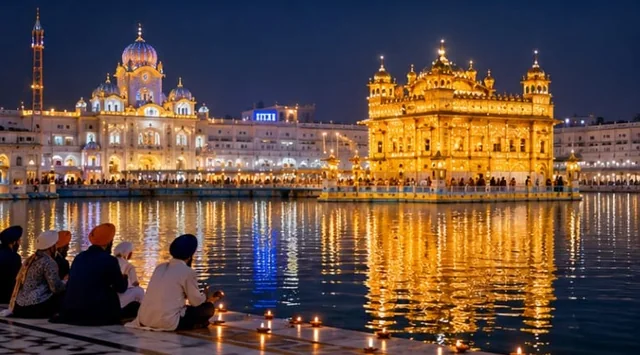
Celebrations begin two days earlier with an Akhand Path, the unbroken 48-hour reading of the Guru Granth Sahib, and Prabhat Pheris, early-morning processions singing shabads. The day before, a Nagar Kirtan led by the Panj Pyare carries the Guru Granth Sahib through the streets. On Gurpurab, gurdwaras hold kirtan and katha from early morning, serve langar to everyone who comes, and light up for the night. Guru Nanak's teachings of one God (Ik Onkar), honest work (kirat karni) and sharing with others (vand chhakna) are at the centre of the day.
Guru Nanak Dev Ji was born in 1469 in Talwandi (today called Nankana Sahib), to Mehta Kalu and Mata Tripta Devi. His elder sister, Bebe Nanaki, was the first to recognise the divine light in the child. When the time came for the sacred-thread ceremony, the young Nanak asked for a different janeu: “Make me a thread that will never break — spun from the cotton of compassion, the thread of contentment, and the twist of truth.” Once, his father gave him twenty rupees to do profitable business. Nanak spent it feeding hungry and needy people he met on the way, saying — what profit can be greater than feeding the hungry? This “Sacha Sauda,” the True Bargain, became the seed of the langar tradition.
Another loved sakhi tells of Bhai Lalo, a poor, hardworking carpenter, and Malik Bhago, a rich man of the town: Guru ji chose Bhai Lalo's simple dry roti over the rich man's feast — for one was earned with honesty and the other with exploitation. At Haridwar he gently questioned empty ritual: while everyone offered water eastward to their ancestors, he poured his westward — “I am watering my fields in Punjab,” he smiled, teaching that living service matters more than show. His three golden teachings live on: Naam Japo (remember the Divine), Kirat Karo (earn honestly), Vand Chhako (share with others). After long journeys with his companion Bhai Mardana, he settled at Kartarpur by the Ravi, farming, singing and serving langar to all.
Purnima tithi11:42 PM, 23 Nov – 8:23 PM, 24 Nov
How Gurpurab is observed
Akhand Path: the unbroken reading of the Guru Granth Sahib over about 48 hours, ending on the morning of Gurpurab.
Nagar Kirtan: a procession led by the Panj Pyare, with the Guru Granth Sahib carried in a decorated palki, gatka displays and kirtan.
On the day: Asa di Var in the early morning, kirtan, katha of Guru Nanak's life and an ardas, followed by karah prasad and langar for all.
At night: gurdwaras and homes are lit with lamps and lights, and kirtan often continues late; Guru Nanak Dev Ji is traditionally remembered as born in the early hours.
Ik Onkar, Sat Naam, Karta Purakh, Nirbhau, Nirvair, Akaal Moorat, Ajooni, Saibhang, Gur Prasad.
"One Creator, whose name is Truth, the Maker, without fear, without hate, timeless, unborn, self-existent, known by the Guru's grace." These words of Guru Nanak Dev Ji open the Guru Granth Sahib.
Questions about Guru Nanak Jayanti 2026
When is Guru Nanak Jayanti in 2026?
Tuesday, 24 November 2026, on Kartik Purnima. The Akhand Path usually begins on 22 November so that it ends on the morning of Gurpurab, and Nagar Kirtans are often taken out on 23 November. Local gurdwaras set their own programme.
What is a Prabhat Pheri?
An early-morning procession in which the sangat walks through the neighbourhood singing shabads. Prabhat Pheris are held for days or even weeks before Gurpurab, and families along the route welcome the sangat with tea and snacks.
Guru Nanak Dev Ji's life, his teachings and how Gurpurab is celebrated are on our Guru Nanak Jayanti page.
Tuesday, 24 November 2026Dev Deepawali · Kartik Purnima
Kartik Purnima evening · Tripuri Purnima
In 2027: Dev Deepawali falls on Saturday, 13 November, the only evening on which the Kartik Purnima is running (Purnima 9:55 AM, 13 November – 8:55 AM, 14 November). The Kartik Purnima snan is on Sunday, 14 November.
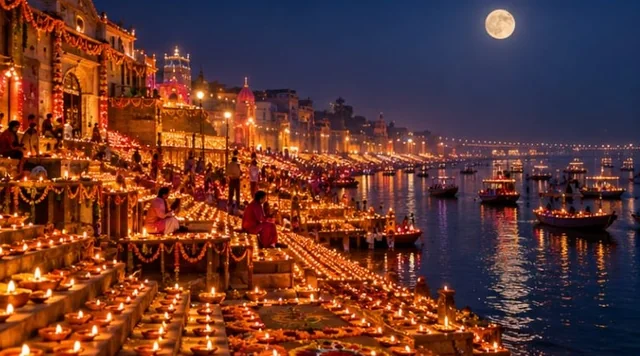
Kartik Purnima closes the holy month of Kartik. It is also called Tripuri Purnima, after Lord Shiva's victory over the demon Tripurasura, and the gods are said to come down to the ghats of Kashi to celebrate it with lamps. That evening is Dev Deepawali, "the Diwali of the gods", when the riverfront ghats of Varanasi are lit with lakhs of diyas and the Ganga aarti draws huge crowds.
Purnima lasts until about 8:23 PM on 24 November, so it covers both the morning snan and the evening lamps of that day. Across India people take a dip in the Ganga or another holy river, give charity, and light lamps at temples and riverbanks. Kartik Purnima is also the day of the Pushkar fair in Rajasthan and of Boita Bandana in Odisha, when people float little boats in memory of ancient sea voyages.
Kartik Purnima is remembered as Tripuri Purnima — the day Lord Shiva freed the worlds from the Tripurasuras. Tarakasura's three sons — Tarakaksha, Kamalaksha and Vidyunmali, together called Tripurasura — had received a remarkable boon and built three flying cities of gold, silver and iron, the Tripura, which would align in a single line only once in a thousand years; only one arrow, at that single moment, could destroy them. Drunk on this protection, the three began to oppress all three worlds, and the defeated gods took refuge with Lord Shiva.
When the thousand-year moment came, Shiva became Tripurantaka: the whole creation itself formed his war-chariot, and with one arrow he destroyed the three cities as they aligned, freeing heaven, earth and the nether world. It is said the gods celebrated this victory by lighting lamps in Kashi — and so Kartik Purnima is celebrated as Dev Deepawali, the Diwali of the gods, when the ghats of the Ganga glow with rows of diyas.
Purnima tithi11:42 PM, 23 Nov – 8:23 PM, 24 Nov
Sunset, 24 Nov (New Delhi)5:24 PM
Pradosh Kaal, Varanasi5:08 PM – 7:47 PM
How the day is kept
Take a dip in the Ganga or another river or sarovar at sunrise, or bathe at home with a little Ganga jal in the water.
Offer water to the sun and worship Vishnu or Shiva; many people also hear the Satyanarayan katha.
Give dakshina and daan: food, warm clothes, lamps or sesame.
In the evening, light lamps at a temple, a riverbank, the tulsi and the doorway. In Varanasi the ghats are lit in Pradosh Kaal and the Ganga aarti follows.
Said while lighting a lamp: "I bow to the light of the lamp, which brings what is good, health and prosperity, and removes ill will."
Questions about Dev Deepawali 2026
When is Dev Deepawali in 2026?
Tuesday, 24 November 2026, on the evening of Kartik Purnima. In Varanasi the lamps are lit in Pradosh Kaal, from sunset at about 5:08 PM to 7:47 PM. Purnima ends at 8:23 PM.
When is the Kartik Purnima snan in 2026?
On the morning of Tuesday, 24 November. Purnima begins at 11:42 PM on 23 November, so the whole morning of the 24th is in Purnima, and the dip is taken at or before sunrise.
The New Delhi timings for each festival day of November 2026. Sunrise decides which tithi a day belongs to, moonrise matters for vrats that are completed after seeing the moon, and many families avoid starting a puja or new work during Rahu Kaal. What sunrise, moonrise and Rahu Kaal mean.
Panchang for festival days, November 2026, New Delhi (IST)
Calculated for New Delhi in Indian Standard Time. Sunrise, sunset, moonrise and Rahu Kaal change with your city, while tithi times are the same moment across India. Other panchangs may differ by a minute or two.