- Date in 2027
- Wednesday, 14 April
- Marks
- 1 Vaisakh, the sun entering Mesha
- Sun enters Mesha
- About 3:28 PM, 14 April (IST)
- For Sikhs
- Khalsa Sajna Diwas
- Also
- Sangrand of Vaisakh
Two reasons to celebrate
Baisakhi, also written Vaisakhi, falls on the first day of the solar month of Vaisakh, when the sun moves into Mesha. In Punjab and Haryana it is the harvest festival of the rabi crop: the wheat stands golden in the fields, and farmers celebrate before the cutting begins.
For Sikhs it is above all Khalsa Sajna Diwas. On Vaisakhi in 1699, at Anandpur Sahib, Guru Gobind Singh Ji called the sangat together and asked who would give his head for the faith. Five men came forward one after another, the Panj Pyare, and were initiated with Amrit, beginning the Khalsa with its five articles of faith.
The same solar new year is kept across India under other names: Vishu in Kerala, Bohag Bihu in Assam, Puthandu in Tamil Nadu, Pana Sankranti in Odisha and Pohela Boishakh in Bengal.
The birth of the first Sikh Guru is celebrated on Guru Nanak Jayanti, on Kartik Purnima.
The story of Baisakhi
Baisakhi carries two joys together. In the fields of Punjab it is the harvest festival — the wheat has ripened, and farmers thank the Divine for the fruit of a season of hard work, with fairs, folk song and dance. In Sikh tradition the day is remembered above all for the Sajna (creation) of the Khalsa in 1699 at Anandpur Sahib by the tenth Guru, Guru Gobind Singh Ji.
On that day, five devoted Sikhs who stepped forward in a spirit of complete dedication became the Panj Pyare — the Five Beloved Ones. The Guru initiated them into the Khalsa through Amrit Sanchar, and then himself received Amrit from their hands — Guru and disciple standing equal. The Khalsa received a shared identity of courage, equality and service, rising above distinctions of caste and birth. That is why Baisakhi is not only a harvest thanksgiving but a celebration of dedication, equality and selfless service.
Vaisakhi at the gurdwara
- Akhand Path: an unbroken reading of the Guru Granth Sahib, completed on the morning of Vaisakhi.
- Nishan Sahib: in many gurdwaras the Nishan Sahib is taken down, its pole washed and the flag replaced with a new one.
- Nagar Kirtan: processions led by the Panj Pyare, with the Guru Granth Sahib in a decorated palki, kirtan and gatka.
- Amrit Sanchar: many Sikhs choose Vaisakhi to take Amrit and join the Khalsa.
- Langar and kirtan: the day ends, as every Gurpurab does, with kirtan, ardas, karah prasad and langar for all.
- Takht Sri Kesgarh Sahib and Takht Sri Damdama Sahib: the largest gatherings are at Anandpur Sahib and at Talwandi Sabo, where a big Vaisakhi mela is held.
The harvest festival
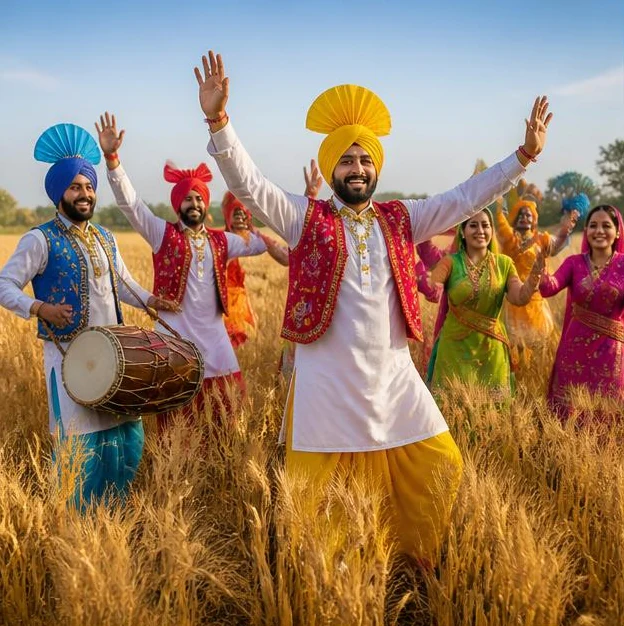
- Bhangra and giddha: men dance bhangra and women giddha to the dhol, often in the open fields or at village fairs.
- Melas: village fairs with wrestling, music, food stalls and swings are held across Punjab.
- Holy dip: Hindus mark Mesha Sankranti with a bath in a river or sarovar; large crowds bathe at Haridwar.
- Food: kadhi-chawal, sarson da saag with makki di roti, meethe chawal, kheer and lassi are made at home.
Vaisakhi also carries a painful memory. On 13 April 1919, a Vaisakhi day, British troops fired on an unarmed crowd gathered at Jallianwala Bagh in Amritsar, and the day is remembered there every year.
Vaisakh in the Barah Maha
In gurdwaras on the Sangrand of Vaisakh the sangat hears the verse for the month from the Barah Maha of Guru Arjan Dev Ji, which speaks of the longing of the soul for the Beloved.
Barah Maha, Raag Majh (Guru Arjan Dev Ji)
वैसाखि धीरनि किउ वाढीआ जिना प्रेम बिछोहु॥
Vaisakh dhiran kiu vadhiaa jina prem bichhohu.
"In Vaisakh, how can the bride be patient, separated from the love of her Beloved?" The verse goes on to say that only the one who meets the Lord finds peace.
Dates and timings for 2027
Baisakhi usually falls on 13 or 14 April. In 2027 the sun enters Mesha in the afternoon of 14 April, so the Sangrand of Vaisakh and Baisakhi are both on Wednesday, 14 April. Published transit times differ by a few minutes between panchangs, which does not change the date. See all Sangrand dates.
Timings are for New Delhi (IST). Checked against Officeholidays, AstroSage and BirthAstro (New Delhi Sankranti lists), Astrovachmi and our own calculation.
All 2027 festivals, vrats, Purnima, Amavasya and Sangrand dates are in our 2027 festival calendar.
Questions about Baisakhi (Vaisakhi)
When is Baisakhi in 2027?
On Wednesday, 14 April 2027, which is 1 Vaisakh. The sun enters Mesha at about 3:28 PM (IST) that day.
Why is Vaisakhi important for Sikhs?
On Vaisakhi in 1699 Guru Gobind Singh Ji founded the Khalsa at Anandpur Sahib by initiating the Panj Pyare with Amrit. The day is celebrated as Khalsa Sajna Diwas.
Is Baisakhi the same as Mesha Sankranti?
They fall on the same day. Baisakhi is the Punjabi harvest festival and Khalsa Sajna Diwas; Mesha Sankranti is the sun's entry into Mesha, kept across India as a solar new year under many names.
What is the difference between Baisakhi and Vaisakhi?
None: they are two spellings of the same festival, named after the month of Vaisakh.
Festival customs vary by region and family. Follow the practice of your own family and temple where it differs from what is written here.