- Date in 2027
- Thursday, 15 April
- Malayalam date
- Medam 1
- Sun enters Mesha
- About 3:28 PM, 14 April (IST)
- Celebrated in
- Kerala, and parts of Karnataka's coast
- Key ritual
- Vishukkani at dawn
About Vishu
Vishu marks the sun's entry into Mesha, the first sign of the zodiac, and is celebrated in Kerala as the beginning of the astronomical new year on the first day of the Malayalam month of Medam. ("Vishu" refers to the equinox; the festival keeps the name although the date has drifted to mid-April.) The Malayalam calendar year itself, the Kollavarsham, begins later, in Chingam, so Vishu is a new year of the sun and the harvest rather than of the calendar.
The heart of the day is the belief that whatever you see first on Vishu morning shapes the year ahead. That is why the Vishukkani, "the first sight of Vishu", is arranged with such care the night before.
The Vishukkani tradition
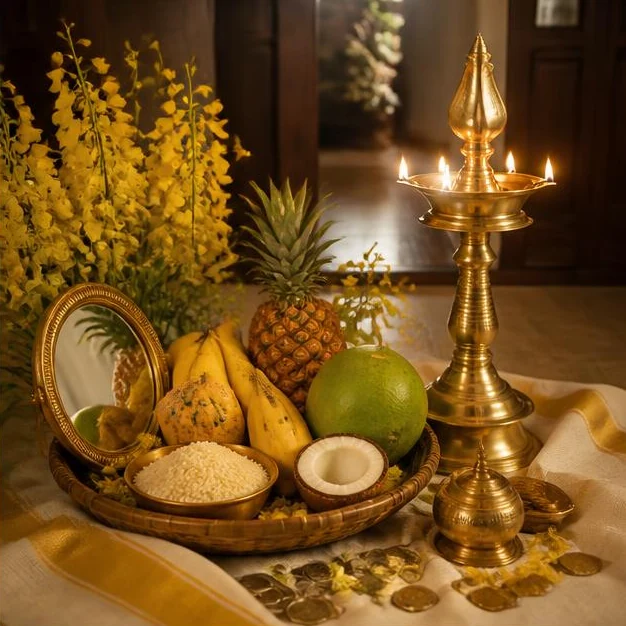
Vishu is the traditional New Year of Kerala, falling on the first day of the Malayalam month of Medam, when the sun enters Mesha (Aries). Unlike festivals built around a single legend, the heart of Vishu is a beautiful household tradition — the Vishukkani, the “first sight” of the new year. On the night before Vishu, the eldest woman of the home arranges a sacred display in a large uruli vessel: golden kani konna flowers, rice, a golden cucumber, fruits and vegetables, coins, fresh kasavu cloth, a traditional mirror, a holy book and a lit nilavilakku lamp, placed before an image of Lord Krishna.
Early in the morning, family members are led with eyes closed to this display, so that the very first thing they see in the new year is light, gold, food and plenty — for tradition holds that what you first see shapes the year within you. Elders then give coins to the young (Vishu kaineettam), new clothes (puthukodi) are worn, and the family shares the Vishu sadhya — a feast on a banana leaf where every taste of life is present together.
How to arrange the Vishukkani
What goes into the kani
- A bell-metal uruli, the wide shallow vessel used for the kani
- Raw rice and paddy, with a golden cucumber (kani vellari) placed on top
- Bunches of yellow konna flowers (Indian laburnum, Cassia fistula), which bloom in Kerala just before Vishu
- Jackfruit, mango, bananas and halved coconuts
- Betel leaves and areca nut, gold ornaments and coins
- A mirror (often an Aranmula valkannadi), a washed and folded kasavu mundu, and a holy book
- A picture or idol of Lord Krishna or Vishnu, and a lit nilavilakku (bell-metal lamp)
Vishu morning
- The eldest woman of the house sets up the kani the night before and lights the nilavilakku before dawn.
- She then wakes each member of the family and leads them, eyes covered, to the kani, so that it is the first thing they see.
- Each person opens their eyes before the kani, offers a prayer and looks at their face in the mirror among the gold and flowers.
- The kani is later shown to the cattle and to neighbours who have none, and the rice and fruit are cooked for the day's meals.
Prayer before the kani
ॐ नमो भगवते वासुदेवाय॥
Om Namo Bhagavate Vasudevaya.
Many families greet the kani with Lord Krishna's name or this twelve-syllable mantra, since the kani is arranged before his image.
Kaineetam, sadya and fireworks
- Vishu kaineetam: elders give coins or notes to the children and younger members of the family, a blessing for prosperity in the year ahead.
- Vishu sadya: a vegetarian feast on a banana leaf, with dishes that bring together sweet, sour, salty and bitter, such as veppampoo rasam made with neem flowers and mampazha pulissery with ripe mango.
- Vishu kanji and katta: in some regions the day's meal is a rice and coconut-milk kanji, or vishu katta, rice cooked in coconut milk and set into squares.
- Padakkam: children burst crackers on Vishu eve and morning.
- Temples: devotees gather for Vishukkani darshan at Guruvayur, Sabarimala (which opens for the Vishu festival) and Sree Padmanabhaswamy Temple.
Dates and timings for 2027
When the sun enters Mesha late in the day, as it does in 2027, Kerala begins Medam and celebrates Vishu on the following morning. A few all-India listings still show 14 April, the day of the transit; Kerala's own calendars and holiday lists give 15 April.
Timings are for New Delhi (IST). Checked against Prokerala, Officeholidays (Kerala) and publicholidays.in for the date, and Astrovachmi and our own calculation for the sankranti time.
All 2027 festivals, vrats, Purnima, Amavasya and Sangrand dates are in our 2027 festival calendar.
Questions about Vishu
When is Vishu in 2027?
On Thursday, 15 April 2027, Medam 1 in the Malayalam calendar. The sun enters Mesha at about 3:28 PM (IST) on 14 April; because this is late in the afternoon, Kerala observes Vishu the next morning.
What is kani vellari?
The golden cucumber placed in the Vishukkani, a sign of a good harvest.
What is Vishu kaineetam?
The gift of money from elders to the younger members of the family on Vishu morning, as a blessing for the year.
Festival customs vary by region and family. Follow the practice of your own family and temple where it differs from what is written here.