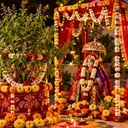
- Karwa Chauth 2027
- Monday, 18 October
- Tithi
- Kartik Krishna Chaturthi
- Puja muhurat (New Delhi)
- 5:49–7:04 PM
- Moonrise (New Delhi)
- 7:35 PM
- Fast
- From sunrise until moonrise, usually nirjala
About Karwa Chauth
Karwa Chauth is the fast married women keep for the long life and wellbeing of their husbands, mainly in Punjab, Haryana, Delhi, Rajasthan, Uttar Pradesh and Madhya Pradesh. It falls on the Chaturthi of Kartik Krishna Paksha (Ashwin in the amanta calendar used in parts of western and southern India), four days after Sharad Purnima.
The Karwa Chauth vrat katha
The best-known story is of Veeravati, the only sister of seven brothers, who kept her first Karwa Chauth fast at her parents' home. As evening came she grew faint, and her brothers, unable to bear it, lit a fire behind a tree and held up a sieve so it looked like the rising moon. She broke her fast, and soon after word came that her husband had died. Through a year of devotion and by keeping the next Karwa Chauth faithfully, she won his life back. The story is why the fast is completed only after the real moon is seen.
The Heart of Karwa Chauth
Behind the fast and the rituals, Karwa Chauth rests on three quiet values:
- Niyat — a heartfelt wish: the day begins with a sincere prayer for your partner's happiness, health and long life. This pure intention is what gives the fast its meaning.
- Anushasan — gentle discipline: staying without food and water from sunrise to moonrise teaches patience and self-control, and reminds us that love also means restraint and resolve.
- Samarpan — wholehearted devotion: accepting your partner just as they are, and standing beside them in every season of life.
A bond does not grow strong through one person's fast alone. It grows when both partners care for each other, respect each other and stand together — that is the lasting message of Karwa Chauth.
How Karwa Chauth is kept today
- Sargi: before dawn the mother-in-law gives a sargi of fruit, sweets, dry fruit and mathri, and the fast begins at sunrise, usually nirjala (without water).
- Evening puja: women dress in bridal red with mehendi and shringar, gather with a decorated thali holding a karwa (a clay or metal spouted pot), a diya, roli and sweets, and listen to the Karwa Chauth katha while passing the thalis around the circle.
- Moonrise: when the moon rises, she looks at it through a chhalni (sieve), offers arghya from the karwa, then looks at her husband through the same sieve. He gives her the first sip of water and bite of food to end the fast.
In 2027 the Chaturthi begins at 5:51 PM on 18 October and is running when the moon rises at 7:35 PM, so the moon is offered arghya on the night of 18 October. Moonrise is the time families watch most closely, and it changes by city, sometimes by half an hour or more.
Puja samagri and vidhi
Puja samagri
- A karwa (spouted pot) of clay, copper or brass with a lid, filled with water for the arghya
- A thali with roli, kumkum, haldi, akshat (unbroken rice), a ghee diya, incense and flowers
- A chhalni (sieve) for looking at the moon
- A picture of Karwa Mata or Chauth Mata, often printed with Gauri, Shiva, Ganesh, Kartikeya and the moon
- Sweets, fruit, mathri and a little dry fruit for the offering
- The baya: sweets, dry fruit, a sari or shringar items, given to the mother-in-law or an elder woman
Puja vidhi
- Eat the sargi before sunrise, then take the sankalpa for the fast with water in your right palm.
- Keep the fast through the day. In most families it is nirjala, without water, until the moon is seen.
- After sunset, set up the picture of Karwa Mata, place the water-filled karwa and the thali before it, and worship Ganesh, Gauri and Shiva with roli, akshat, flowers and a diya.
- Sit with the other women of the family or neighbourhood to hear the katha, passing the thalis around the circle (the pheri) as the verses are sung.
- Give the baya to your mother-in-law or an elder woman and touch her feet for her blessing.
- When the moon rises, look at it through the chhalni, offer arghya from the karwa, then look at your husband through the same chhalni. He offers the first sip of water and the first bite of food to end the fast.
Mantra
Ganesh vandana
वक्रतुण्ड महाकाय सूर्यकोटि समप्रभ।
निर्विघ्नं कुरु मे देव सर्वकार्येषु सर्वदा॥
Vakratunda mahakaya suryakoti samaprabha,
nirvighnam kuru me deva sarvakaryeshu sarvada.
Most pujas begin with Lord Ganesh, asking that the work go ahead without obstacles.
Sankalpa for the fast
मम सुखसौभाग्य पुत्रपौत्रादि सुस्थिर श्री प्राप्तये करक चतुर्थी व्रतमहं करिष्ये॥
Mama sukha-saubhagya putra-pautradi susthira shri praptaye karaka chaturthi vratam aham karishye.
Said in the morning: "I will keep the Karak Chaturthi fast for happiness, good fortune and lasting prosperity for my family."
Puja muhurat and moonrise time, 18 October 2027
Moonrise by city on Karwa Chauth, 18 October 2027
| City | Moonrise (IST) |
|---|---|
| New Delhi | 7:35 PM |
| Chandigarh | 7:31 PM |
| Ludhiana | 7:34 PM |
| Amritsar | 7:37 PM |
| Dehradun | 7:27 PM |
| Jaipur | 7:45 PM |
| Lucknow | 7:24 PM |
| Patna | 7:09 PM |
| Kolkata | 7:03 PM |
| Bhopal | 7:47 PM |
| Ahmedabad | 8:07 PM |
| Mumbai | 8:15 PM |
| Hyderabad | 7:55 PM |
| Bengaluru | 8:08 PM |
| Chennai | 7:57 PM |
Calculated moonrise at the horizon. The moon usually becomes visible a few minutes later behind buildings or haze, so keep the thali ready a little early.
Every festival of the month is on our October 2026 festivals page.
Questions about Karwa Chauth 2027
When is Karwa Chauth in 2027?
Monday, 18 October 2027. The Chaturthi tithi begins at 5:51 PM that evening and is running when the moon rises at 7:35 PM. The fast is kept from sunrise on the 18th (6:23 AM in New Delhi) and broken after moonrise the same night.
What time will the moon rise on Karwa Chauth 2027?
7:35 PM in New Delhi. It rises earlier in the east (around 7:03 PM in Kolkata) and later in the west and south (around 8:15 PM in Mumbai). The table above lists more cities. Buildings, hills or haze can delay the first sight of the moon by a few minutes.
What is sargi, and when is it eaten?
Sargi is the pre-dawn meal a mother-in-law gives her daughter-in-law: fruit, dry fruit, sweets, mathri and sometimes pheni or parathas. It is eaten before sunrise, which in New Delhi is 6:23 AM on 18 October, and the fast begins after it.
What if the moon is hidden by clouds?
Families follow their own custom. Many wait for the moon to appear; others offer arghya facing the east at the calculated moonrise time and break the fast, and some look at an image of the moon or a lit diya. Ask an elder in the family which practice you follow.
Can unmarried women or husbands keep the fast?
Yes, many do. Unmarried women often keep it for a good life partner, sometimes breaking it on seeing the stars, and many husbands now fast alongside their wives. Women who are pregnant, unwell or on medication usually keep a lighter fast with water or fruit, which is entirely in keeping with the spirit of the vrat.