- Date in 2027
- Sunday, 18 July
- Tithi
- Ashadha Purnima
- Also called
- Vyasa Purnima
- Honours
- Ved Vyasa and one's own teachers
- Next day
- Sawan begins in North India, 19 July
Why Guru Purnima is celebrated
Guru Purnima is the day of the guru, the teacher. It falls on the full moon of Ashadha, the night the monsoon has usually settled in, and it is also called Vyasa Purnima because tradition holds that the sage Ved Vyasa was born on this day, to the fisherwoman Satyavati and the sage Parashara.
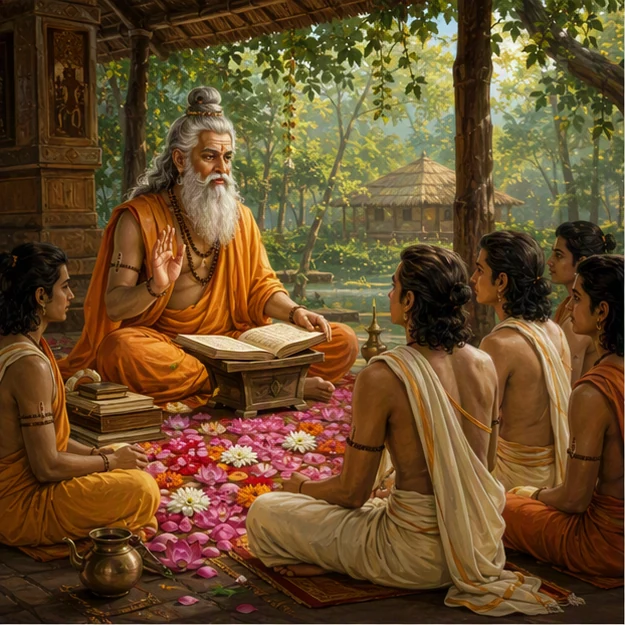
Vyasa is honoured as the first teacher of the Hindu tradition. He is said to have arranged the one Veda into four (which is how he came to be called Veda Vyasa, "the one who divided the Veda"), composed the Mahabharata, and taught the Puranas to his disciples. Every teacher who passes on that knowledge is seen as sitting in his seat, which is why the guru puja on this day is called Vyasa Puja.
The word itself carries the meaning of the day. An old verse of the Advaya Taraka Upanishad explains gu as darkness and ru as that which removes it: the guru is the one who takes away the darkness of not knowing.
The story of Veda Vyasa
Guru Purnima is also Vyasa Purnima, the birth anniversary of Maharishi Veda Vyasa — the son of Rishi Parashar and Mata Satyavati, born on an island in the Yamuna, and so also called Krishna Dvaipayana. In his age, the Veda existed as one vast ocean of knowledge carried by memory alone, growing harder for later generations to hold. Vyasa ji organised that one Veda into four — Rigveda, Yajurveda, Samveda and Atharvaveda — so that separate lines of disciples could carry each forward; from this work of arranging (“vyasa” means the one who arranges or divides) came his very name, Veda Vyasa, and tradition remembers that this great organising too was completed on this Purnima.
He composed the Mahabharata — tradition says he dictated it and Lord Ganesh wrote it — and is credited with the eighteen Puranas. Above all, he did not keep knowledge with himself: he taught it to his disciples, and that unbroken line of teaching is the true meaning of the Guru — the one who shares light. This is why, on Guru Purnima, every student honours their own teacher.
Guru Purnima across traditions
- In ashrams and mathas, disciples gather for Vyasa Puja and the guru's darshan. Sannyasis take their Chaturmas vow on this day and stay in one place through the four months of the rains, teaching and studying.
- In music and dance, students of the guru-shishya tradition visit their teachers with flowers, fruit and a gift, and many schools of classical music hold a day of performances in the guru's honour.
- For Buddhists, the Ashadha full moon (Asalha Puja) marks the Buddha's first sermon, given to five ascetics in the Deer Park at Sarnath, when he "set the wheel of Dhamma in motion". Monks begin the three-month rains retreat, Vassa, soon after.
- For Jains, the Chaturmas of monks and nuns begins around the same full moon, and Jain communities honour their acharyas.
- In Nepal, Guru Purnima is kept as Teachers' Day in schools.
How to keep Guru Purnima at home
Puja samagri
- A picture of Ved Vyasa, of your own guru, or of the guru's padukas (sandals)
- Sandalwood paste, kumkum, akshat and fresh flowers or a garland
- A ghee lamp, incense and camphor for the aarti
- Fruit, sweets or panchamrit for naivedya
- A new cloth, a book, or dakshina to give to your teacher
Puja vidhi
- Bathe early, wear clean clothes and set up the picture on a clean seat, facing east or north.
- Begin with a short prayer to Lord Ganesh, then light the lamp and incense.
- Offer sandalwood, akshat, flowers and the naivedya to Vyasa or your guru's picture, and chant the guru mantra below.
- Read a few verses of the Guru Gita, the Vishnu Sahasranama or the scripture your guru taught, or simply spend some time in silence.
- If you can, visit your guru or teacher in person, touch their feet, and offer fruit, a cloth or dakshina with thanks.
- Many people keep a Purnima fast through the day and eat after the evening puja or after seeing the moon.
Guru mantra
गुरुर्ब्रह्मा गुरुर्विष्णुः गुरुर्देवो महेश्वरः।
गुरुः साक्षात् परब्रह्म तस्मै श्रीगुरवे नमः॥
Gurur Brahma Gurur Vishnuh Gururdevo Maheshvarah,
Guruh sakshat Parabrahma tasmai Shri Gurave namah.
"The guru is Brahma, the guru is Vishnu, the guru is Lord Maheshvara. The guru is the Supreme itself: salutations to that guru."
Vyasa vandana
व्यासाय विष्णुरूपाय व्यासरूपाय विष्णवे।
नमो वै ब्रह्मनिधये वासिष्ठाय नमो नमः॥
Vyasaya Vishnurupaya Vyasarupaya Vishnave,
namo vai brahmanidhaye Vasishthaya namo namah.
"Salutations to Vyasa, who is Vishnu in form, and to Vishnu in the form of Vyasa, the treasure of the Veda, the descendant of Vasishtha."
You do not need a formal guru to keep the day. Many families honour their parents, the teachers who shaped them, or Lord Shiva as Dakshinamurthy, the first teacher, or Lord Dattatreya. A phone call or a letter to an old teacher is as much in the spirit of the day as any ritual.
Chaturmas and the start of Sawan
Guru Purnima falls four days after Devshayani Ekadashi (14 July 2027), when Lord Vishnu is said to go to sleep and the four months of Chaturmas begin. In the purnimanta calendar followed across North India, the next day, Monday 19 July 2027, is the first day of Shravana, or Sawan, the month of Lord Shiva. That makes 19 July the first Sawan Somwar of the year, and the start of the season of the Kanwar Yatra.
Dates and timings for 2027
On 17 July the Purnima begins only in the evening, after sunset. On 18 July it is the tithi at sunrise and lasts until 9:14 PM, so Guru Purnima, the Vyasa Puja and the Purnima fast are all kept on Sunday, 18 July.
A penumbral lunar eclipse on 18 July 2027 is too slight to be seen. We have not added any sutak timing for it; if panchangs publish guidance, we will add it here.
Timings are for New Delhi (IST). Checked against our own tithi calculation and published 2027 panchangs.
Every festival and vrat of the month, with Pradosh, Sangrand, Purnima and Amavasya, is on our July 2027 festivals page.
All 2027 festivals, vrats, Purnima, Amavasya and Sangrand dates are in our 2027 festival calendar.
Questions about Guru Purnima
When is Guru Purnima in 2027?
On Sunday, 18 July 2027. The Ashadha Purnima tithi runs from 6:48 PM on 17 July to 9:14 PM on 18 July, so the 18th has the Purnima at sunrise and through the day.
Why is Guru Purnima also called Vyasa Purnima?
Because the sage Ved Vyasa, who arranged the Vedas and composed the Mahabharata, is believed to have been born on this full moon. He is honoured as the first guru, and the guru puja of the day is called Vyasa Puja.
Can I celebrate Guru Purnima if I do not have a guru?
Yes. You can honour your parents and the teachers who taught you, or worship Lord Shiva as Dakshinamurthy or Lord Dattatreya as the guru of all. Thanking a teacher in person is a good way to keep the day.
Is there an eclipse on Guru Purnima 2027?
A penumbral lunar eclipse falls on 18 July 2027, but it only grazes the edge of the earth's outer shadow, so the moon will not look any different. We have not seen panchang guidance on sutak for it, and will add any here once it is published.
What should I offer my guru on Guru Purnima?
Traditionally fruit, flowers, a new cloth and dakshina, given with a namaskar or by touching the guru's feet. What matters most is the thanks and the intention to keep learning.
Festival customs vary by region and family. Follow the practice of your own family and temple where it differs from what is written here.