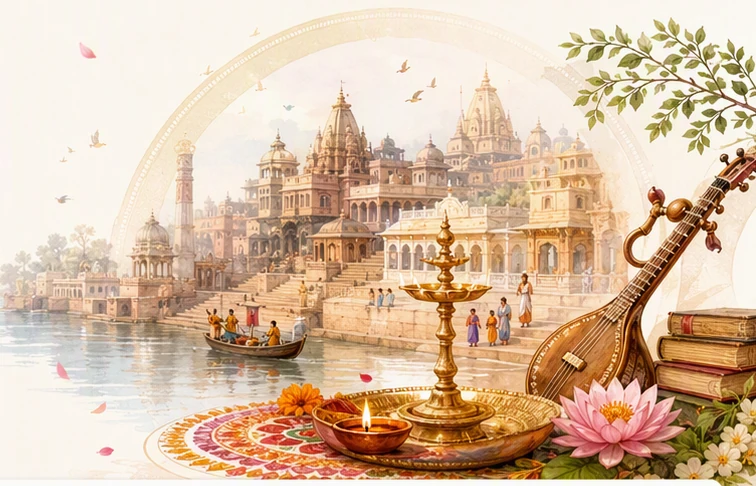
- Hindu months
- Chaitra and Vaishakha
- Chaitra Navratri
- 7–15 April
- Amavasya
- Tuesday, 6 April (Chaitra, Bhaumvati)
- Purnima
- Tuesday, 20 April (Chaitra Purnima)
- Ram Navami
- Thursday, 15 April · madhyahna 11:04 AM – 1:38 PM
Finding a date: the table below lists this month's festivals and vrats by date. Tap a name to see its timings and details, or to open its full guide. “Back to the list” after each festival brings you back to the table.
April 2027 at a glance
| Date | Festival or vrat |
|---|---|
| Fri 2 | Papmochani Ekadashi |
| Sun 4 | Pradosh Vrat |
| Mon 5 | Masik Shivratri |
| Tue 6 | Chaitra Amavasya · Bhaumvati Amavasya |
| Wed 7 | Chaitra Navratri begins · Gudi Padwa · Ugadi |
| Fri 9 | Gangaur |
| Wed 14 | Baisakhi · Sangrand: Vaisakh begins · Goru Bihu |
| Thu 15 | Ram Navami · Vishu · Manuh Bihu |
| Sat 17 | Kamada Ekadashi |
| Sun 18 | Pradosh Vrat |
| Mon 19 | Mahavir Jayanti |
| Tue 20 | Hanuman Jayanti · Chaitra Purnima |
| Sat 24 | Sankashti Chaturthi |
Festivals with their own guide are linked. Pradosh Vrat, Masik Shivratri and Sankashti Chaturthi come every month and are explained once in our 2027 festival calendar. Muslim and other festivals of the month are not covered on this page.
Gangaur
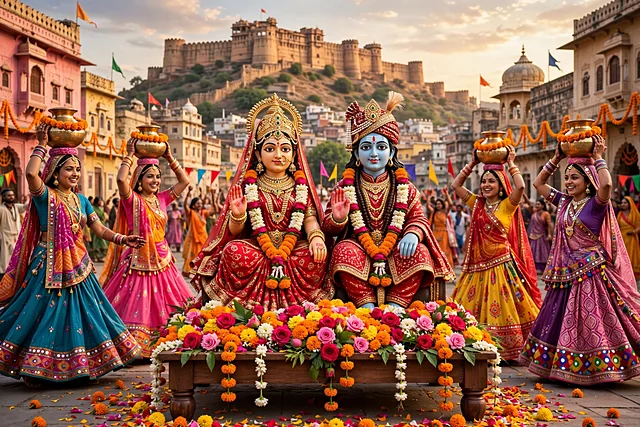
Main day: Friday, 9 April 2027, Chaitra Shukla Tritiya. The name joins Gan, meaning Shiva, and Gaur, meaning Gauri or Parvati. The festival belongs above all to Rajasthan, with Jaipur, Udaipur, Bikaner and Jodhpur at its heart, and it is also kept in the Nimar and Malwa regions of Madhya Pradesh and in parts of Gujarat.
Why it is celebrated
Gangaur celebrates the sacred companionship of Shiva and Parvati, and with it the love, trust and devotion of family life. Married women keep the vrat for the happiness and prosperity of their families and the long life of their husbands, and unmarried girls keep it hoping for a good life partner. It also welcomes spring and the new harvest as Chaitra arrives. Above all it is a festival of women coming together, whose songs, mehndi and shared puja link one generation with the next.
How it is celebrated today
From the day after Holi, for a little over two weeks, clay figures of Isar and Gangaur are set up in homes and worshipped every morning with traditional Gangaur songs. Women dress in Rajasthani lahariya and bandhej, with mehndi on their hands. In many places, towards the end of the festival, unmarried girls carry a clay pot with a lamp inside it, the ghudlia, from house to house singing songs, and are given sweets and small gifts. On the main day there is a special puja and the katha, and Jaipur and Udaipur see grand processions of Gangaur Mata in a palanquin, with folk music and dance. At the close the figures are given a fond farewell and immersed in a lake or tank, and sweets such as ghevar are made at home in this season.
More in our Gangaur guide.
Ram Navami
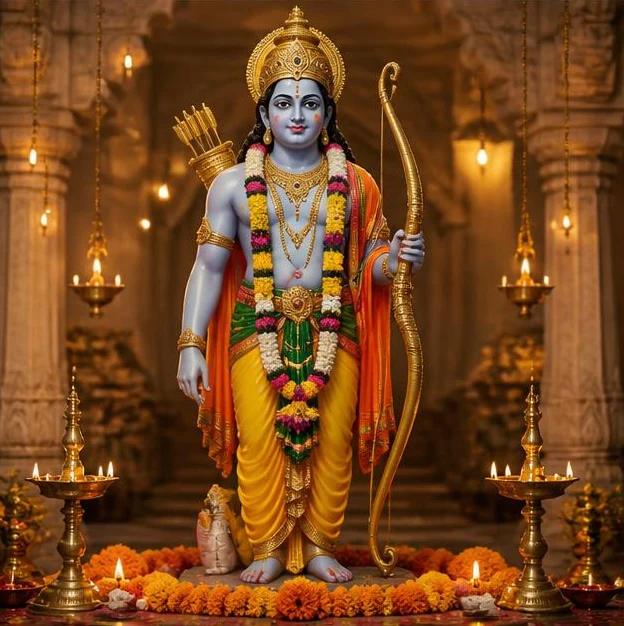
Thursday, 15 April 2027. Ram Navami celebrates the birth of Lord Rama in Ayodhya. According to the Valmiki Ramayana he was born at midday on the Navami of the bright half of Chaitra, so the main puja is done in the madhyahna, which in New Delhi is from 11:04 AM to 1:38 PM. The Navami ends at 1:21 PM, so many families time the birth-time puja and the cradle ceremony for the first part of the window. It is also the last day of Chaitra Navratri.
Watch the video on the festival page
The story of Shri Ram's birth
Ram Navami celebrates the birth of Shri Ram in Ayodhya. King Dasharatha of Ayodhya had three queens — Kaushalya, Sumitra and Kaikeyi — but no child, and the king longed for an heir. On the advice of Guru Vasishtha, the king performed the Ashvamedha and Putrakameshti yagyas, conducted by Sage Rishyasringa. From the yagya fire a divine being emerged bearing a vessel of sacred payasam, which was shared among the three queens. In time, four sons were born: to Kaushalya, Ram; to Kaikeyi, Bharat; and to Sumitra, Lakshman and Shatrughn — Guru Vasishtha performed their naming.
Behind this joyful birth lay the prayers of the gods: the demon king Ravan had received a boon that he could not be defeated by gods, gandharvas or demons — but he had not thought to ask protection from humans. So the gods prayed, and Vishnu chose to be born as a human prince. Tradition remembers the exact sacred moment of the birth: Chaitra Shukla Navami, at midday (madhyahna), in Punarvasu nakshatra — which is why the main Ram Navami puja and the Ram Janm celebration in temples take place at noon, with conches, bells and the swinging of the cradle of the newborn prince of Ayodhya.
The puja vidhi and the traditions of the day are in our full Ram Navami guide.
Mahavir Jayanti

Monday, 19 April 2027, Chaitra Shukla Trayodashi. Mahavir Jayanti, or Mahavir Janma Kalyanak, marks the birth of Bhagwan Mahavir, the twenty-fourth Tirthankara of Jainism. In the morning his idol is given a ceremonial abhishek, temples perform the eightfold ashtaprakari puja, and the idol is carried through the streets on a decorated chariot or palanquin, with bhajans and devotees dressed in white. Monks and nuns give discourses, and families give to charity and support animal shelters. More in our Mahavir Jayanti guide.
Hanuman Jayanti
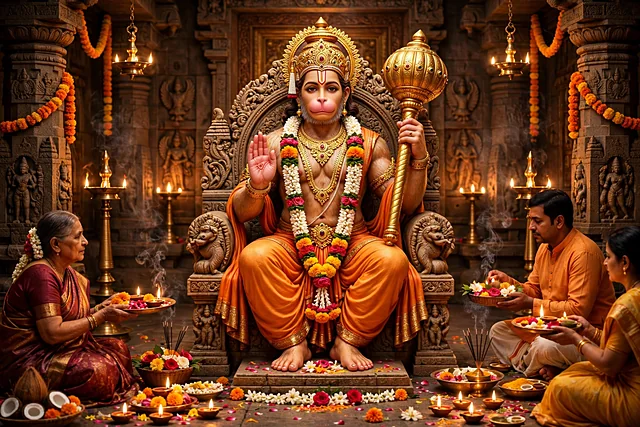
Tuesday, 20 April 2027, Chaitra Purnima. In North India the birth of Lord Hanuman is celebrated on the full moon of Chaitra, and in 2027 the Purnima is the tithi at sunrise on the 20th. Devotees visit Hanuman temples from early morning, offer sindoor, flowers and laddoos, and recite the Hanuman Chalisa, and many keep a fast. Some regions, especially in the South, mark Hanuman Jayanti in other months, by their own calendars.
The katha, puja vidhi and mantra are in our Hanuman Jayanti 2027 guide.
Dates and timings for 2027
Timings are for New Delhi (IST), as given in our Ram Navami guide and 2027 festival calendar.
All 2027 festivals, vrats, Purnima, Amavasya and Sangrand dates are in our 2027 festival calendar.
Questions about April 2027 festivals
When is Gangaur in 2027?
The main day is Friday, 9 April 2027, Chaitra Shukla Tritiya. In many homes the worship of Isar and Gangaur begins the day after Holi.
When is Ram Navami in 2027?
On Thursday, 15 April 2027. The madhyahna muhurat in New Delhi is from 11:04 AM to 1:38 PM.
When is Hanuman Jayanti in 2027?
On Tuesday, 20 April 2027, Chaitra Purnima.
When does Chaitra Navratri begin in 2027?
On Wednesday, 7 April 2027, the Hindu new year. It ends with Ram Navami on Thursday, 15 April.
Festival customs vary by region and family. Follow the practice of your own family and temple where it differs from what is written here.